Markets are closed today, a good day to think rather than react. And right now, across every Indian investor group, the same question keeps coming up: should I be investing in Taiwan and Korea after their blistering run?
Over the past week, one story has been everywhere. On LinkedIn, in the newspapers, across every investor WhatsApp group. Taiwan overtook India as the world’s fifth largest stock market by market capitalisation. MSCI Korea posted 193% in one year. MSCI Taiwan posted 114%. And suddenly, everyone is asking the same question.
Should I be moving money abroad?
It is a fair question. And it deserves a serious answer, not a headline.
So today, instead of watching the ticker, we sat down and wrote the honest version. What people think they are buying when they invest in Taiwan or Korea. What they are actually buying. And what an intelligent answer looks like when the FOMO settles.
Pour the coffee. This one is worth reading carefully.
A Conversation Happening Across Indian Investor Groups Right Now
A friend who manages his own portfolio messaged us last week.
“Yaar, what is happening in India is depressing. Nifty is going nowhere. Meanwhile look at this. Korea is up 193% in one year. Taiwan up 114%. Should I be moving some money there?”
He sent a screenshot. MSCI Korea Index, one year return: +193.2%. MSCI Taiwan Index, one year return: +113.9%. MSCI India: minus 9.8% for the same period.
On May 26, Taiwan officially overtook India as the world’s fifth largest stock market by market capitalisation. WhatsApp groups full of Indian retail investors started asking the same question.
So we want to walk through this carefully. Not to talk anyone out of having Taiwan or Korea exposure. The AI semiconductor theme is genuinely real. But to make sure you understand exactly what you are buying.
Because what is on the label is not what is actually in the bottle.
The Bottle vs The Label
You Bought a Jar. You Got Three Coins.
The contents of a “country ETF” look very different from what the label implies
MSCI Taiwan ETF
₹5.1 lakh of every
₹10 lakh goes to TSMC
₹10 lakh goes to TSMC
MSCI Korea ETF
₹5 lakh of every
₹10 lakh → 2 stocks
₹10 lakh → 2 stocks
The label says “country.” The jar holds three stocks.
What People Think They Are Buying
When an Indian investor decides to invest in Taiwan or Korea, the typical path is straightforward. Buy an ETF or index fund tracking the MSCI Taiwan or MSCI Korea index. The mental model: I am buying a diversified slice of two of Asia’s most advanced economies. Banks. Consumer brands. Technology. Hundreds of names. A country bet.
That is what the label says. Now let us look at what is actually inside the bottle.
What You Are Actually Buying
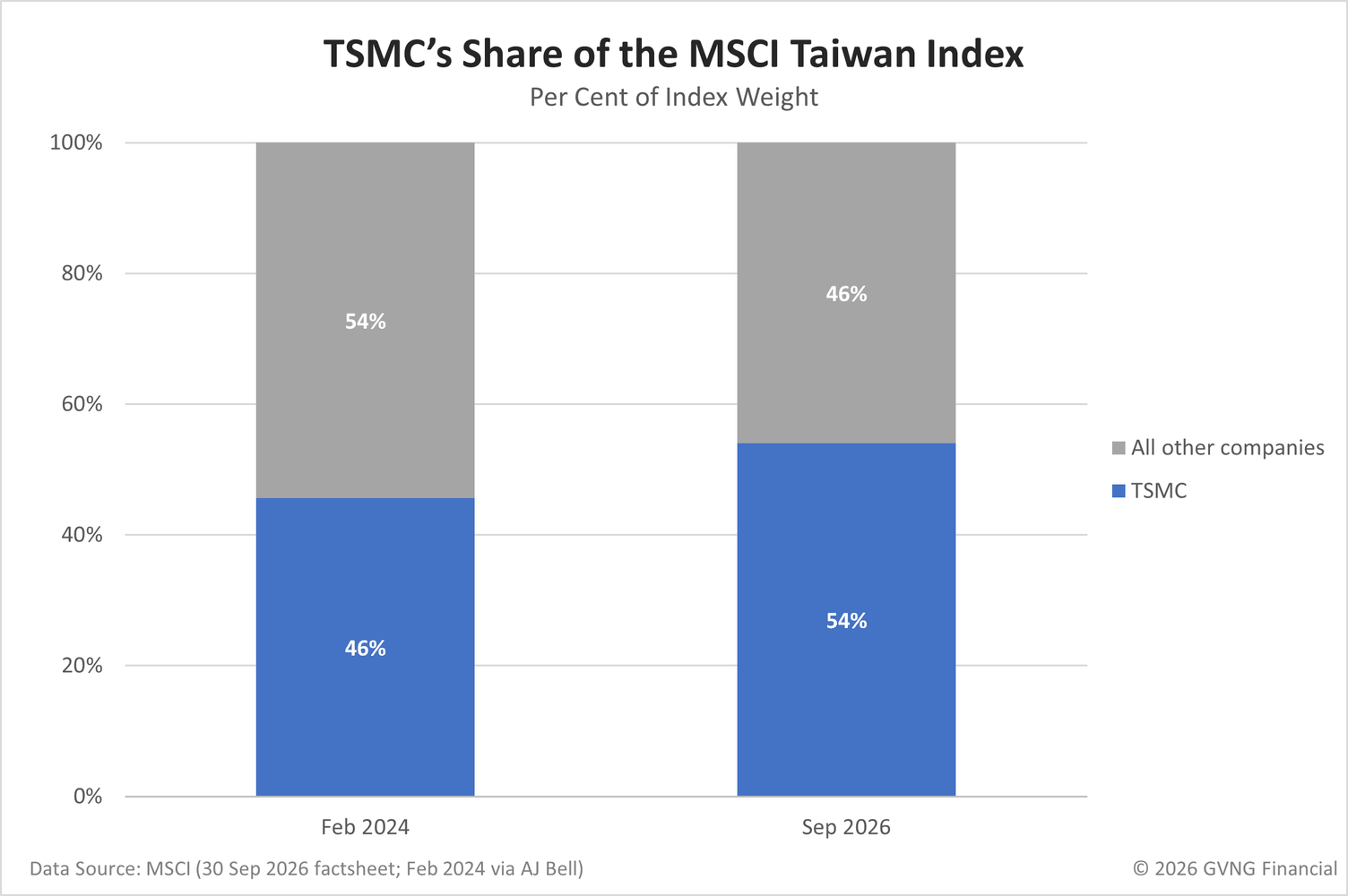
In Taiwan: TSMC now accounts for 54% of the MSCI Taiwan Index. In early 2024, that figure was about 46%. You are no longer buying “Taiwan.” You are buying TSMC, with a small side of everything else.
TSMC is now worth approximately 150% of Taiwan’s entire GDP. The only historical comparison that gets close is Nokia in 2000, which was 230% of Finnish GDP at the dot com peak. We know how that ended.
In Korea: Samsung Electronics (29%) and SK Hynix (21%) account for 50% of the MSCI Korea Index combined. One year ago, that figure was 19%. The concentration has more than doubled in 12 months.
If you buy an MSCI Taiwan index fund with ₹10 lakh, roughly ₹5.1 lakh goes straight into TSMC. If you buy an MSCI Korea index fund with ₹10 lakh, roughly ₹5 lakh goes into Samsung and SK Hynix.
You think you bought a country. You actually bought three stocks.
The Label vs The Contents
What You Think You're Buying vs What Is Actually Inside
The combined picture across MSCI Taiwan and MSCI Korea
What the Label Says
✓Diversified country ETF
✓90–100+ companies per index
✓Banks, consumers, healthcare
✓Geographic diversification
✓Country-level economic exposure
What You Actually Get
TSMC (Taiwan)
54%
Samsung (Korea)
29%
SK Hynix (Korea)
21%
190+ other companies
~remainder
Three AI semiconductor companies. Two country labels. One highly concentrated hardware cycle bet.
Why This Happened: One Product Cycle
Four hyperscalers — Microsoft, Google, Amazon, and Meta — have committed to spending over $300 billion on AI infrastructure in 2025 and 2026.
- TSMC manufactures the advanced chips (3nm, 2nm process) that power every Nvidia GPU and custom AI chip.
- Samsung Electronics is the dominant producer of High Bandwidth Memory (HBM) needed to feed those GPUs.
- SK Hynix is the leading supplier of HBM3e going into Nvidia’s H200 and B100 architectures.
These three companies are the picks and shovels of the global AI gold rush. The earnings are real. But: this is not Taiwan exposure. This is not Korea exposure. This is concentrated AI semiconductor exposure with a country label glued on top.
The 10-Year Number That Quietly Tells the Truth
| Index | 1 Year | 3 Year | 5 Year | 10 Year | 10 Year (Apr 2025) |
|---|---|---|---|---|---|
| MSCI Korea | +193.2% | +40.9% | +13.4% | +14.5% | +1.5% |
| MSCI Taiwan | +113.9% | +45.1% | +20.0% | +22.7% | +11.6% |
| MSCI India | -9.8% | +8.1% | +6.6% | +8.7% | +9.1% |
| MSCI China | +12.4% | +9.8% | -4.5% | +5.5% | +0.5% |
| MSCI Brazil | +54.8% | +20.0% | +11.2% | +9.2% | +2.7% |
| MSCI EM | +46.7% | +20.7% | +6.1% | +9.2% | +3.1% |
| MSCI ACWI | +31.0% | +19.8% | +10.7% | +12.3% | +8.6% |
Net USD returns. Source: MSCI, as of April 30, 2026.
Korea: 1.5% per year over a decade (a year ago). Taiwan: 11.6%. Today: Korea 14.5%, Taiwan 22.7%. One extraordinary year pulled the entire decade’s average up. The 10-year number you see today is mostly about the 1 year.
The Three Biases Pulling Money Toward This Trade
Recency bias. Recent returns feel like evidence of future performance. They are not. The investor who bought Korea in 2019 waited nine years for a year that may not repeat.
Grass is greener bias. Foreign markets look smoother from a distance because you are not tracking their daily potholes. Taiwan and Korea have plenty — geopolitical tension, demographic crisis, single customer dependence.
FOMO. Hearing foreign returns discussed everywhere creates the feeling that everyone else is making money and you are standing still. The feeling becomes the trigger. The analysis comes later, if at all.
Name these three biases before they name your trades.
The Risks That Do Not Show Up in the Return Table
1. Geopolitical risk. Taiwan sits 130 kilometres from mainland China. South Korea shares a militarised border with North Korea. A single incident in either jurisdiction could erase years of returns in days.
2. Demographics. Both countries have among the oldest and fastest-ageing populations in Asia, average age roughly 45 years. The demographic engine is already running in reverse.
3. Single cycle dependence. The entire rally is driven by AI hardware. When AI capex slows or hits an inventory correction, the indices fall with it.
4. No margin of safety. You are not buying TSMC cheap. Late entry into a crowded narrative has historically been one of the most reliable ways to underperform.
Investing in Taiwan and Korea: What Should You Actually Do?
Own the theme, not the geography. Global semiconductor ETFs give you TSMC, Samsung, SK Hynix, NVIDIA, ASML without the geopolitical wrapper.
Use a diversified EM fund as your base. A well-constructed diversified EM fund gives you Taiwan and Korea exposure as part of a broader allocation. When this cycle turns, you are not fully exposed to the correction.
Zoom out to 10 years before you decide. Ask yourself what you believe the annualised return of MSCI Korea will be over the next decade, starting from today’s valuations. Then decide.
A Sensible Way to Size This in a Portfolio
| Layer | What Goes Here | Typical Allocation |
|---|---|---|
| Core | Diversified EM and global equity funds | 60–70% of foreign allocation |
| Satellite | Thematic funds (AI / semiconductors) | 20–30% of foreign allocation |
| Tactical | Single country (Taiwan, Korea) | 0–15% of foreign allocation |
The tactical layer is where your Korea / Taiwan exposure goes. It is not your core. If your total foreign allocation is ₹10 lakhs, the tactical slice is ₹0 to ₹1.5 lakhs. Not the whole thing.
Portfolio Architecture
The Right Way to Size Foreign Exposure
Not all foreign capital belongs in the same bucket. Each layer has a different purpose.
CORE
Diversified EM & Global Equity
Broad index funds across multiple countries and sectors. The structural foundation. No single story risk.
60–70%
of foreign allocation
SATELLITE
Thematic Funds (AI / Semiconductors)
Sector bets sized as what they are — own the AI theme through a semiconductor fund, not a country label.
20–30%
of foreign allocation
TACTICAL
Single Country (Taiwan, Korea)
Highest conviction, highest risk. Size it like what it is — a concentrated bet on one cycle in one geography.
0–15%
of foreign allocation
Example: Foreign allocation of ₹10 lakhs → your Taiwan/Korea (Tactical) slice = ₹0 to ₹1.5 lakhs maximum — not the whole amount.
Where GVNG Comes In
This is exactly the kind of question we spend our days on. Not just whether to invest in Taiwan or Korea, but how to think about it, how to size it, which product to use, and whether it is right for your specific situation.
We help clients access international markets through broking and mutual fund routes, SIPs and SWPs for disciplined exposure, Alternative Investment Funds for qualifying clients, and GIFT City structures for NRIs who want tax and currency advantages.
If you are asking whether you should be moving money to Taiwan or Korea right now, the honest answer is: probably not as a standalone bet, and definitely not because of the last 12 months. But if you want thoughtful international diversification that includes some AI semiconductor exposure as part of a broader architecture, we can help you do that properly.
One Last Thought
The MSCI Taiwan index is up 114% in a year. That number is real. But the investor who bought it 10 years ago earned 11.6% per year. The investor who bought it one year ago earned 114%.
The question is not which of these investors got lucky. The question is which made a decision based on clear thinking, appropriate sizing, and an understanding of what they were actually buying.
Buying the right theme through the wrong package becomes a mediocre outcome. Buying the wrong theme with perfect packaging is still the wrong bet. Know what you are actually buying.
Questions readers ask
Is investing in Taiwan or Korea a good idea for Indian investors?
It can be, but understand what you are buying. The MSCI Taiwan index is about 54% TSMC, so it is a concentrated AI-semiconductor bet, not diversified country exposure. It belongs in a small tactical slice of a portfolio, not the core.
Why is the MSCI Taiwan index so concentrated?
TSMC has grown to roughly 54% of the index, up from about 46% in early 2024, because it makes the advanced chips powering the $300B+ hyperscaler AI capex cycle. TSMC is now worth about 150% of Taiwan's GDP.
What returns have MSCI Taiwan and Korea delivered?
MSCI Korea returned about +193% and MSCI Taiwan about +114% over one year, but far less over ten years (Taiwan roughly +11.6% per year as of April 2025). The one-year number is not the long-run rate.
How much of my portfolio should be in Taiwan or Korea?
A sensible frame: core 60-70% in diversified EM and global funds, satellite 20-30% in thematic AI/semiconductor funds, and tactical 0-15% in single-country bets. Taiwan and Korea belong in the small tactical layer.
Want to build a sensible international portfolio?
We can help you think through global allocation, AI semiconductor exposure, GIFT City structures for NRIs, and what size makes sense for your specific situation.
Book Free Consultation →Disclaimer: This article is for educational purposes only and is not investment advice or a recommendation to buy or sell any security, index, or fund. International investing carries currency, geopolitical, and concentration risks. Please consult a SEBI-registered adviser before making any decision. Past performance is not indicative of future results.
A note from the founder
The label says a country. The contents say a few companies.
I understand the pull of a market that doubled in a year; every investor group seems to be talking about it, and nobody wants to be the one who stayed out.
In shortBut TSMC alone is 54% of the MSCI Taiwan index. The index rose 114% in the last year, yet an investor who bought ten years ago earned 11.6% a year. Buying Taiwan or Korea today mostly means buying two or three chip companies.
If you want this theme, let us decide how much of it belongs in your portfolio before the market decides for you.
Nishith Gandhi
Founder, GVNG Financial, Ahmedabad
25+ years serving families
Founder, GVNG Financial, Ahmedabad
25+ years serving families