The ₹1 Crore Illusion: Why It Is No Longer the Ultimate Retirement Goal
“I need ₹1 crore for retirement.” We have heard this sentence thousands of times. Said with pride, with conviction, as if reaching that number is the finish line. With great respect, and even greater urgency, we are here to tell you it may be the most expensive financial belief of your life.
GVNG Research22 May 2026 · Updated 11 October 2026 · 10 min read
Is ₹1 crore enough for retirement? It is the number everyone chases. But at realistic inflation, ₹1 crore is nowhere near enough for retirement, and the gap is far bigger than almost anyone expects. Here is the real math.
Is ₹1 Crore Enough for Retirement? The Cruel Mathematics of Inflation
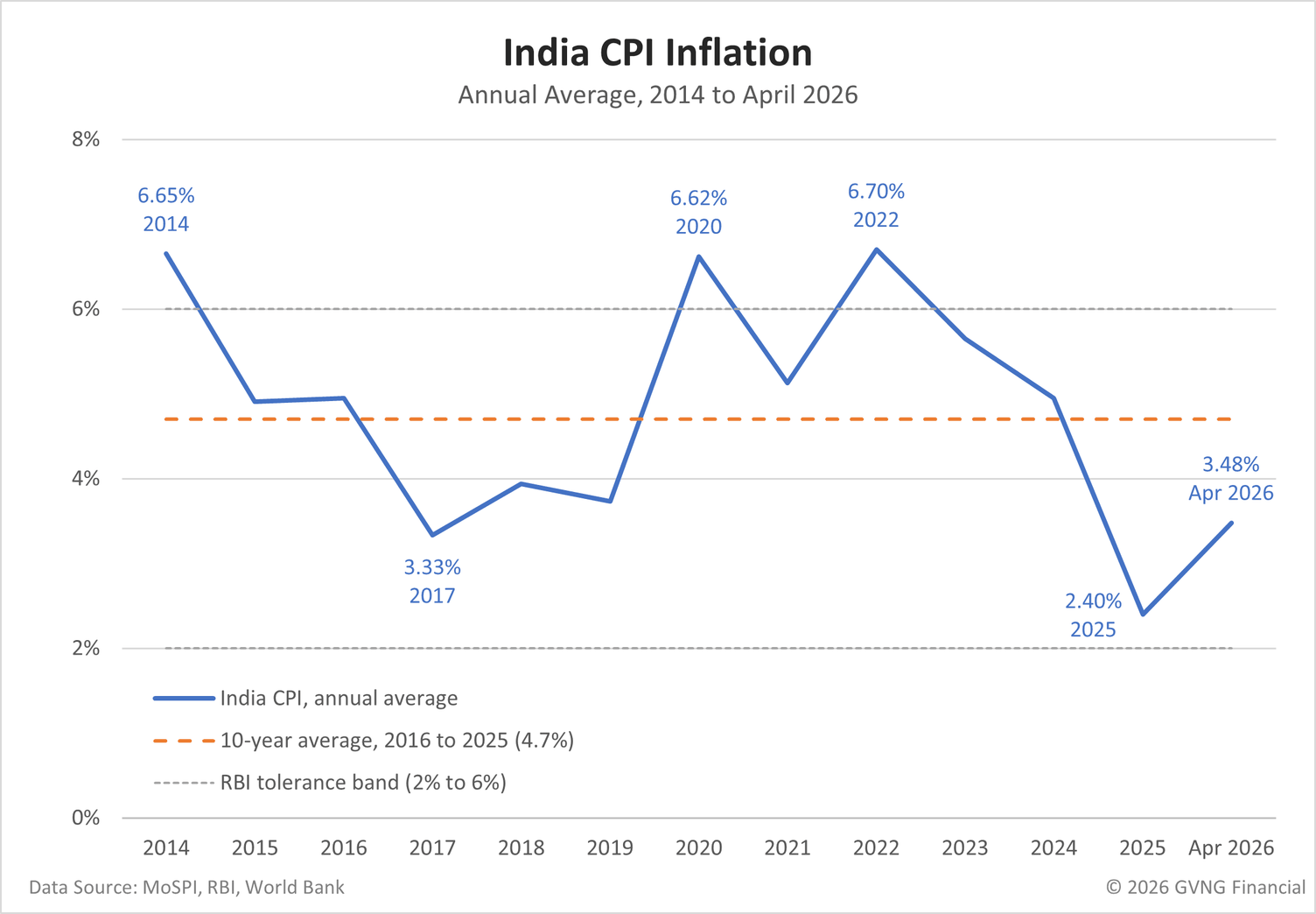
India’s official inflation rate, measured by the Consumer Price Index (CPI), has averaged between 4.5% and 6.5% over the past decade. Yes, the recent trend is encouraging. After peaking at 6.70% in 2022, inflation fell sharply to 5.65% in 2023, and the latest April 2026 reading stands at just 3.48%, helped along by the newly revised CPI series with 2024 as base year. The RBI has maintained a 4% target with a 2 to 6% tolerance band through 2031.
But planning your retirement on today’s inflation number is like driving by looking only at your rearview mirror. Over any 25 to 30 year retirement horizon, inflation will cycle through multiple peaks and troughs. At a seemingly benign 5% average, prices double every 14.4 years. The ₹1 crore sitting in your savings account today will have the purchasing power of roughly ₹47 to 61 lakhs in just 10 to 20 years.
Apr 2026 CPI
3.48%
New 2024 base series
10-Yr Average
4.7%
India CPI, 2016 to 2025
2022 Peak
6.70%
Most recent high
Prices Double
14.4 yrs
at 5%, Rule of 72
India’s Inflation Cycle, A Decade of Peaks and Troughs
CPI annual average from 2014 to 2026 (Apr) | RBI target band shown
A low inflation reading today is welcome news. But retirement planning is a 25 to 40 year exercise, not a 12-month one. The families who retire comfortably planned for inflation cycles, not just the current reading. Today’s 3.48% will not be tomorrow’s number.
How India’s CPI Is Actually Calculated
The Central Statistics Office (CSO) calculates India’s CPI by tracking prices of a fixed basket of goods and services. On 12 February 2026, MoSPI released the new CPI 2024 series (Base 2024=100), based on the Household Consumption Expenditure Survey 2023-24. This is the most significant overhaul of India’s inflation measurement in 14 years. The structure shifted from 6 broad groups to 12 divisions following the international COICOP 2018 framework, with 358 items in all.
CPI = Σ (Weight of Division × Price Index of Division)
India’s CPI Basket, New 2024 Series (COICOP Framework)
Look at the table carefully. Health stands at 6.10% and Education at 3.33%, together just 9.43% of the basket. Yet these two categories are rising at 12 to 18% per year for urban middle-class families. The CPI weight dramatically underrepresents what urban Indians actually spend on staying healthy and educated.
What CPI Does Not Tell Urban India
The CPI basket tilts heavily toward rural, lower-income consumption. For urban, middle-class families, CPI is a severe underestimation of real cost-of-living increases. Here are the two biggest offenders.
Health Insurance Premiums
Star Health Insurance raised premiums by 12 to 14% in FY2024-25. Industry-wide, health premiums rose 10 to 12% in 2025 per IRDAI data. Medical inflation, the cost of hospitalisation, ran at 14% in FY2023-24 per ACKO’s India Health Report. A LocalCircles survey found 52% of policyholders saw premiums rise over 25% in the past year alone.
Education Costs
Private school fees are rising 10 to 15% annually. IIM MBA programme fees grew from roughly ₹10 lakhs in 2010 to ₹24 to 27 lakhs in 2024. Engineering and medical private colleges are rising at 8 to 12% per year. Study-abroad costs in INR terms are climbing 12 to 18% year-on-year, due to a mix of currency and tuition increases.
So here is the urban reality. Headline CPI may read 3.48% today. But if your household spends 15 to 20% of income on healthcare and education, your personal inflation rate is likely running at 6 to 9% per year. Every financial plan that uses headline CPI without adjustment is built on sand.
The most dangerous number in personal finance is not zero. It is a false positive, the number that makes you feel safe when you are not.
Watching ₹1 Crore Silently Shrink
Let us look at what actually happens to the ₹1 crore you are so proud of. The table below shows the real purchasing power of ₹1 crore today across different inflation scenarios. This is money sitting idle in a savings account earning around 3.5%, below inflation. No investment, no spending. Just the silent erosion of wealth.
The Silent Erosion of ₹1 Crore Over Time
Real purchasing power in today’s rupees · Cash in savings account · No investment growth assumed
Year
At 4% Inflation
At 5% Inflation
At 6% Inflation
At 7% (Urban)
Today
₹1,00,00,000
₹1,00,00,000
₹1,00,00,000
₹1,00,00,000
5 Years
₹82,19,271
₹78,35,262
₹74,72,582
₹71,29,862
10 Years
₹67,55,642
₹61,39,133
₹55,83,948
₹50,83,493
15 Years
₹55,52,645
₹48,10,171
₹41,72,704
₹36,24,508
20 Years
₹45,63,869
₹37,68,895
₹31,18,047
₹25,84,190
25 Years
₹37,51,287
₹29,53,028
₹23,30,013
₹18,42,491
30 Years
₹30,83,187
₹23,13,774
₹17,41,101
₹13,13,791
At a realistic urban inflation rate of 7% per year, your ₹1 crore becomes the equivalent of just ₹13.1 lakhs in today’s money within 30 years. A retiree who ‘saved ₹1 crore’ could effectively be living on ₹13 lakhs worth of purchasing power by their mid-80s. That is not retirement. That is financial survival.
Seven Strategies to Beat Inflation and Retire with Real Wealth
The goal is not to save money. The goal is to accumulate real, inflation-adjusted wealth that generates income regardless of what prices do. Here is the framework we use with our clients.
1. Never Treat FDs or Savings Accounts as Wealth Builders
A savings account returning 3 to 4% when inflation is 6 to 7% is a guaranteed wealth destroyer. Fixed deposits returning 6.5 to 7.5% barely keep up, and after 30% tax, you lose ground. These instruments are for liquidity, not retirement. (We wrote a full breakdown of this in our recent piece on Why Your ₹50 Lakh FD Is Quietly Losing You Wealth.)
2. Equity Must Be the Core of Your Long-Term Portfolio
Over any 15-year rolling period, the Nifty 50 has delivered 12 to 15% CAGR. Equities consistently beat inflation over long periods. A 60 to 70% equity allocation in your working years is not aggressive. It is necessary.
3. Real Estate, But Only If the Math Works
Tier-1 real estate has delivered 7 to 10% appreciation plus 2 to 3% rental yield. It moves with inflation. But illiquidity, maintenance costs, and concentration risk make it unsuitable as your only hedge. REITs offer a cleaner, more diversified alternative.
4. Build a Healthcare Corpus Separately
With premiums rising 10 to 14% annually and medical inflation at around 14%, your health insurance premium at age 65 could be ₹2 to 4 lakhs per year. Budget a dedicated healthcare corpus of ₹30 to 50 lakhs in today’s money, separate from your retirement corpus.
5. Use the NPS Intelligently
NPS offers a ₹50,000 additional deduction under Section 80CCD(1B), on top of the 80C limit. The equity tier, Scheme E, invests in a low-cost index portfolio. It is among the most tax-efficient equity vehicles available, yet chronically underused.
6. Invest in Children’s Education Fund Early
If education costs rise at 10% per year and your child is 5 today, a ₹20 lakh degree will cost ₹52 lakhs by the time they turn 18. Starting a dedicated fund the day your child is born, not at age 15, is the difference between comfort and crisis.
7. Plan for Income in Retirement, Not Just a Corpus
Target building a portfolio that generates 3.5 to 4% annual income sustainably. Dividend-paying equities, REIT rental income, SWPs from mutual funds, and NPS annuities create income streams that grow with inflation, rather than a fixed pile that shrinks.
What Is Your Real Retirement Number?
Your retirement number is personal, based on your expected expenses, retirement age, life expectancy, and the inflation-adjusted return your portfolio generates. Use the framework below to estimate yours.
The India-Adjusted Withdrawal Rule. India’s 10-year G-Sec yield currently sits at around 7.08%, well above US and EU equivalents. With a real yield (yield minus inflation) of over 3.5%, Indian retirees with a balanced equity-debt portfolio can sustain a 3.5 to 4% withdrawal rate. Your corpus should target 25 to 30 times your annual retirement expenses in inflation-adjusted future rupees.
Retirement Corpus Calculator
Enter your numbers. See your real retirement target instantly.
₹
Your current monthly household spending
yrs
How old are you today
yrs
When you plan to retire
%
Urban middle-class often 6 to 8%
%
3.5 to 4% is India-appropriate
30yrs
Auto-calculated from your ages
Monthly expenses at retirement
₹4,30,729
Inflated to your retirement year
Retirement Corpus Needed
₹14.77 Crore
at 3.5% safe withdrawal rate
Annual income at retirement
₹51.69 Lakh
First year of retirement
A 30-year-old spending ₹75,000 today, retiring at 60 with 6% inflation, will need a corpus of about ₹14.77 crore.
Please check your inputs. Retirement age must be greater than current age, and all values must be positive.
Building Your Retirement Blueprint, The Right Way
After 25 years in India's markets, we have seen the patterns clearly. The families who retire with dignity did not do dramatically different things. They did ordinary things, consistently, in the right order.
The Wealth-Building Hierarchy
Step 1, Protect First. Term life insurance covering 20 times your annual income, plus adequate health insurance, before any investment. Your biggest financial risk is not market volatility, it is a single uninsured medical emergency.
Step 2, Eliminate Toxic Debt. Credit card debt and personal loans at 18 to 36% interest make all investment returns irrelevant. Clear these before building wealth.
Step 3, Emergency Fund. Six months of expenses in a liquid fund or high-yield savings account. Not more, not less.
Step 4, Invest for Goals. Every surplus rupee goes toward goal-based investments, retirement corpus, children’s education, home purchase, in order of time horizon and priority.
Step 5, Review Annually. A financial plan made today is obsolete in three years without review. Inflation changes. Tax laws change. Your income changes. Your plan must reflect current reality.
The difference between financial independence and financial struggle in India is rarely income. It is the quality of your financial decisions over 20 to 25 years.
Good decisions, compounded over time, are overwhelmingly powerful. Silence is the worst decision of all.
One Last Thought
The number ₹1 crore is not wrong. It is just incomplete.
It was a good target in 2000, when a litre of petrol cost ₹30 and a private school cost ₹30,000 a year. It is a starting point in 2026, not a destination.
Your retirement number is whatever amount, growing at whatever rate, will let you live the life you actually want, 25 or 30 years from now, in money that buys what you need then, not what it bought today.
That number is bigger than you think. The good news is that the gap is bridgeable, if you start now, allocate correctly, and let compounding do the heavy lifting. That is the entire job of a wealth practice like ours. To take the abstract anxiety of retirement and turn it into a concrete monthly habit you can actually sustain.
Questions readers ask
Is 1 crore enough for retirement in India?
Usually not. At 7% urban inflation, ₹1 crore today has the buying power of only about ₹13 lakh in 30 years. A comfortable retirement typically needs 25 to 30 times your annual expenses in inflation-adjusted terms, which is often several crore.
How much does inflation reduce 1 crore over time?
At 5% inflation, ₹1 crore falls to about ₹61 lakh of buying power in 10 years and about ₹23 lakh in 30 years. At 7% urban inflation, it drops to about ₹13 lakh in today's money within 30 years.
What is the real retirement corpus I need?
Target roughly 25 to 30 times your annual retirement expenses, calculated in future inflation-adjusted rupees, so the corpus can sustain a 3.5 to 4% annual withdrawal rate through a 25 to 30 year retirement.
Why is urban inflation higher than the headline CPI number?
Health and education, which rise 10 to 18% a year for urban families, are underweighted in the CPI basket (together about 9.4%). So urban middle-class households often experience 6 to 9% personal inflation even when headline CPI reads lower.
How can I retire with ₹1 crore in India?
Only if your household spends little. On the 3.5 to 4% withdrawal rate this article uses, ₹1 crore supports about ₹3.5 to 4 lakh a year, roughly ₹29,000 to ₹33,000 a month in today's money. The target corpus is 25 to 30 times your annual expenses, so a family spending ₹6 lakh a year needs about ₹1.5 to 1.8 crore. Keep equity at the core of the portfolio, build a separate healthcare corpus of ₹30 to 50 lakh, and draw income through SWPs rather than leaving the money in FDs. The retirement calculator works out your own number.
How long will ₹1 crore last in retirement?
It depends on what you spend. If the portfolio earns about 3.5% a year above inflation and your spending rises with inflation, ₹1 crore lasts roughly 24 years at ₹50,000 a month in today's money, about 13 years at ₹75,000 and about 9 years at ₹1 lakh. At ₹30,000 a month, inside the 3.5 to 4% withdrawal rate, it can last a lifetime. Returns are not guaranteed; the retirement calculator works out the corpus your spending needs.
What will ₹1 crore be worth after 30 years?
In today's money, ₹1 crore kept as cash is worth about ₹30.8 lakh after 30 years at 4% inflation, ₹23.1 lakh at 5%, ₹17.4 lakh at 6% and ₹13.1 lakh at 7% urban inflation. Put the other way, keeping today's buying power would take about ₹5.74 crore in 30 years at 6% inflation, or ₹7.61 crore at 7%.
Your Retirement Is Too Important to Leave to Guesswork
Stop planning with a number someone else told you was good enough. Let us build your personalised, inflation-proof retirement plan together. 45 minutes. No sales pitch. Just clarity, and your real number.
Reviewed by Nishith Gandhi, GVNG Financial · Published 22 May 2026 · Sources: MoSPI, RBI
Disclaimer: This article is for educational purposes only and is not investment, tax, or retirement advice. Inflation and return figures are illustrative estimates and actual outcomes will vary. The calculator provides indicative projections only. Please consult a SEBI-registered adviser before making financial decisions.
A note from the founder
Your retirement is not a number. It is thirty years of living.
For a generation, ₹1 crore sounded like the finish line, and I understand why: it took a lifetime of discipline to reach.
In shortBut inflation compounds too. A retiree who saved ₹1 crore could be living on about ₹13 lakh of today's purchasing power by their mid-80s. Your real number is the corpus that pays for the life you want, for as long as you live it, in tomorrow's rupees.
Let us work out that number together, and the monthly habit that gets you there.
The ₹1 Crore Illusion: Why It Is No Longer the Ultimate Retirement Goal
Summarising
The short answer
No. At a realistic urban inflation rate of 7%, ₹1 crore left in a savings account buys only what ₹13.1 lakhs buys today after 30 years.
A 30-year-old spending ₹75,000 a month, retiring at 60 with 6% inflation, needs a corpus of about ₹14.77 crore. The gap can be closed: start early, keep equity at the core and plan for a steady income, not one round number.
01Is ₹1 Crore Enough for Retirement? The Cruel Mathematics of Inflation
India's CPI inflation averaged 4.5% to 6.5% over the past decade. It peaked at 6.70% in 2022 and read only 3.48% in April 2026 on the new 2024-base series. The RBI's target is 4%, within a 2% to 6% band, through 2031.
Today's low reading is the rear-view mirror. Over a 25 to 30 year retirement, inflation will rise and fall many times, and at a 5% average, prices double every 14.4 years.
So ₹1 crore sitting in a savings account will buy only what roughly ₹47 to 61 lakhs buys today within 10 to 20 years.
On 12 February 2026 MoSPI released the new CPI series (base 2024 = 100), the biggest change in 14 years: 12 divisions under the international COICOP 2018 framework and 358 items, built on the 2023-24 household spending survey.
Food and beverages carry 36.75% of the basket and housing, water, power and fuel 17.67%. Health is just 6.10% and education 3.33%.
Together, health and education are only 9.43% of the index, yet for urban middle-class families these costs are rising 12 to 18% a year. The official number underweights exactly what you spend most on.
The CPI basket leans toward rural, lower-income spending, so it understates what urban middle-class families actually face.
Health: Star Health raised premiums 12 to 14% in FY2024-25; industry premiums rose 10 to 12% in 2025 (IRDAI); hospital costs ran at 14% in FY2023-24 (ACKO); and 52% of policyholders in a LocalCircles survey saw premiums jump over 25% in a single year.
Education: private school fees rise 10 to 15% a year; an IIM MBA went from about ₹10 lakhs in 2010 to ₹24 to 27 lakhs in 2024; study abroad costs climb 12 to 18% a year in rupees.
If health and education take 15 to 20% of your income, your personal inflation is likely 6 to 9% a year, not 3.48%.
The test case is cash in a savings account earning around 3.5%, less than inflation, so it loses value every year without anyone noticing.
After 30 years, ₹1 crore is worth about ₹30.8 lakhs at 4% inflation, ₹23.1 lakhs at 5%, ₹17.4 lakhs at 6% and only ₹13.1 lakhs at 7%, the realistic urban rate.
Even after 10 years at 7%, it is down to about ₹50.8 lakhs. A retiree who 'saved ₹1 crore' could be living on ₹13 lakhs of buying power by their mid-80s.
05Seven Strategies to Beat Inflation and Retire with Real Wealth
FDs and savings accounts are for liquidity, not wealth. A savings account at 3 to 4% loses to 6 to 7% inflation; FDs at 6.5 to 7.5% barely keep up and fall behind after 30% tax.
Equity at the core: over any 15-year rolling period the Nifty 50 has delivered 12 to 15% CAGR, so 60 to 70% in equity during working years is necessary, not aggressive. Property (7 to 10% growth plus 2 to 3% rent) works only if the math does; REITs are a cleaner route.
Separate pots for health and children: a health premium at 65 could be ₹2 to 4 lakhs a year, so keep a ₹30 to 50 lakh healthcare corpus apart. A ₹20 lakh degree rising 10% a year costs ₹52 lakhs by the time a 5-year-old turns 18.
Use NPS and plan for income: NPS gives an extra ₹50,000 deduction under Section 80CCD(1B). Build a portfolio that pays 3.5 to 4% a year through dividends, REITs, SWPs and annuities, so your income grows with prices.
Your corpus should be 25 to 30 times your annual retirement expenses, counted in future, inflation-adjusted rupees.
India's 10-year G-Sec yields about 7.08%, a real yield above 3.5%, so a balanced Indian portfolio can sustain a 3.5 to 4% withdrawal rate.
Worked example from the calculator: ₹75,000 a month today becomes ₹4,30,729 a month at 60 with 6% inflation. That needs about ₹14.77 crore at a 3.5% withdrawal rate, giving ₹51.69 lakh of income in the first year.
07Building Your Retirement Blueprint, The Right Way
The order matters more than the products. Protect first: term cover of 20 times annual income plus proper health insurance, before any investment.
Clear toxic debt (credit cards and personal loans at 18 to 36%), then keep six months of expenses in a liquid fund as an emergency fund.
Only then invest every surplus rupee by goal and time horizon, and review the plan every year: without review, a plan is out of date within three years.
₹1 crore is not wrong, just incomplete. It was a good target in 2000, when petrol was ₹30 a litre and a private school cost ₹30,000 a year; in 2026 it is a starting point.
Your real number is the amount that lets you live the life you want 25 or 30 years from now, in that day's prices. It is bigger than you think, but the gap closes if you start now and let compounding do the work.
Is ₹1 crore enough? Usually not: at 7% urban inflation it buys what about ₹13 lakh buys today after 30 years. At 5%, it is worth about ₹61 lakh in 10 years.
The real target: about 25 to 30 times your yearly retirement spending, in future rupees, so a 3.5 to 4% withdrawal can last a 25 to 30 year retirement.
Why your inflation runs higher: health and education rise 10 to 18% a year but weigh about 9.4% in CPI, so city households often live with 6 to 9%.
A summary of the article above, written by GVNG Research. Every chart, table and source is in the full article. For information only, not investment advice.