Indian stock market in winter: what November to February did to the Nifty and every sector since 2022
Five winters of NSE data, 36 years of the Sensex and the research on seasons and share prices. The season is busy for business. It has rarely been kind to the index.
Winter is when India spends: Diwali, weddings, the busiest months for flights and hotels, the wheat sowing, then the Union Budget on the first of February. If any season should be good for share prices, it feels like this one.
We checked: every NSE daily closing file since 2021, all 1,331 sessions, then 36 years of the Sensex and the research on seasons and share prices. Winter here means the last close of October to the last close of February. The Indian stock market in winter has not behaved the way the season feels.
The short answer
From November to February the Nifty 50 fell in four of the last five winters. It rose only in 2023-24, by 15.22%. Since 2006, January and February are the only months in which the Sensex has fallen on average. No sector index rose in all five winters; government-owned companies came closest. Each sector typically did better in the four months before winter. What decided each winter was foreign money, the Budget, and one surprise nobody had in the calendar.
Markets in winter: five winters, one by one
Indian shares from November to February
Last October close to last February close. Source: NSE
Winter
Nifty 50
Midcap 100
Smallcap 100
Strongest sector index
Weakest sector index
2021-22
-4.97%
-7.37%
-8.57%
Metal +5.99%
Realty -12.49%
2022-23
-3.93%
-4.18%
-5.48%
PSU Bank +5.70%
Energy -18.71%
2023-24
+15.22%
+24.33%
+26.30%
Realty +51.00%
Media -6.78%
2024-25
-8.60%
-14.61%
-20.98%
Bank -6.08%
Media -31.31%
2025-26
-2.11%
-1.19%
-7.90%
PSU Bank +19.99%
Realty -17.62%
Three of the four losing winters were followed by eight months that made the money back, and more. Not this year: from the end of February to 9 October 2026 the Nifty 50 is down 10.56%.
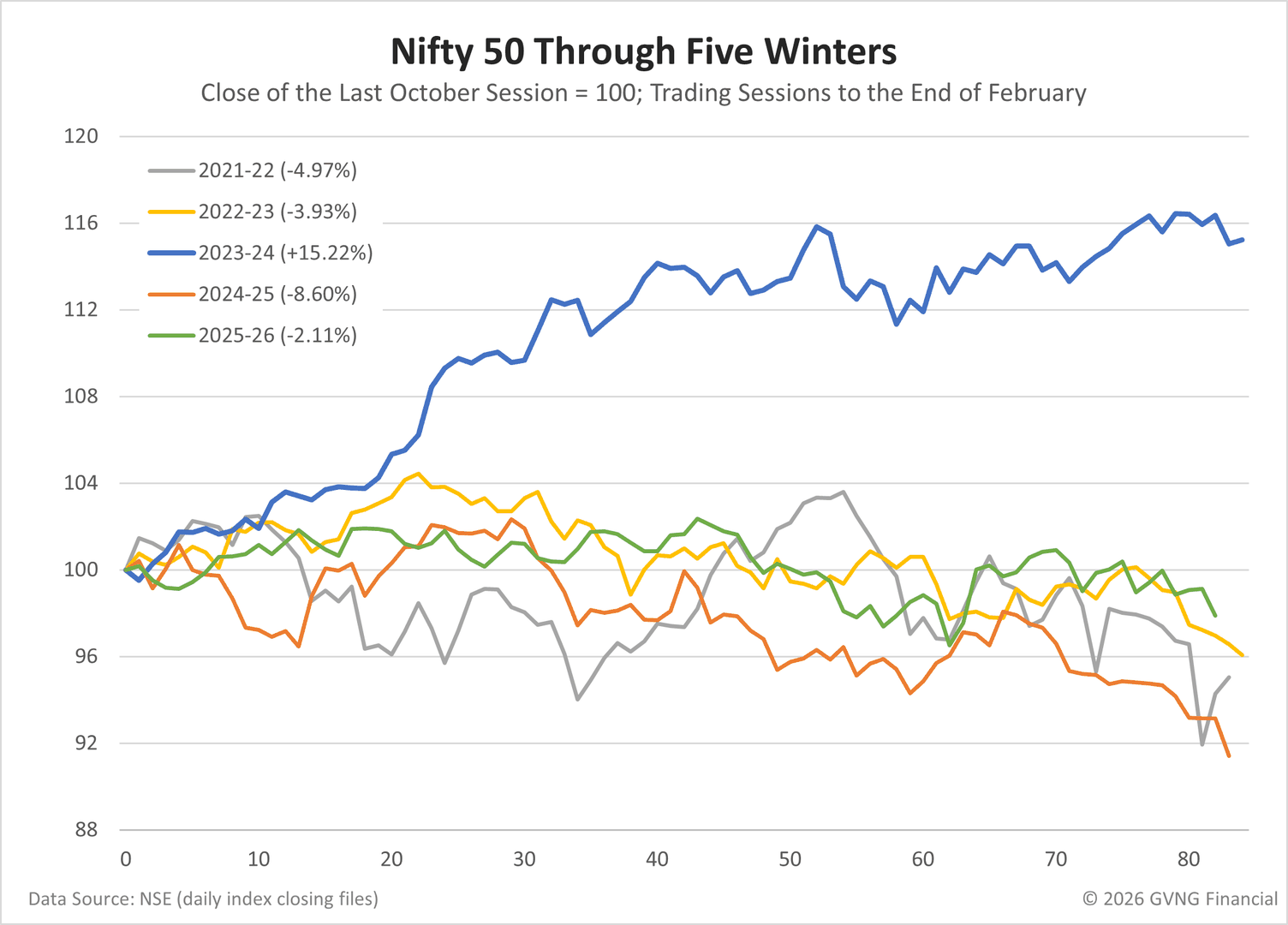
Four of the last five winters ended lower for the Nifty 50
November to February, and the March to October that followed
Data source: NSE daily index closing files. Past returns do not tell you future returns.
One winter rose from start to finish. The other four gave way in January and February
Nifty 50, last October close = 100
Data source: NSE daily index closing files.
2021-22: a new virus, then a war
The Nifty 50 fell 4.97%, and two days did most of it: the day the World Health Organization named the Omicron variant, and the day Russia invaded Ukraine. Foreign portfolio investors (FPIs), the overseas funds that buy and sell Indian shares, sold in all four months: ₹93,866 crore. Only Metal and Energy rose, as the war pushed commodity prices up.
2022-23: a record in December, a shock in January
The Nifty 50 closed at a record 18,812.50 on 1 December 2022 and still ended the winter 3.93% lower than it began. On 24 January 2023 the US firm Hindenburg Research published a report on the Adani group, whose companies sat in the energy indices. Nifty Energy fell 8.3% in January and 8.6% in February, and FPIs sold ₹28,852 crore in January.
2023-24: the winter that worked
The one winter that fits the story people tell. Three things lined up: four state election results on 3 December 2023, a signal ten days later that US interest rate rises were over, and FPI buying of ₹66,135 crore in December, the largest month in our five years. Realty rose 51.00%, CPSE (central government companies in power, oil, coal and defence) 48.78% and PSU Bank 40.44%.
2024-25: five falling months in a row
The Nifty 50 fell every month from October to February; five in a row had last happened in 1996. FPIs sold ₹1,18,767 crore, ₹78,027 crore of it in January 2025, and growth for July to September was first reported at a weak 5.4%. Good news did not help: the Budget removed income tax on incomes up to ₹12 lakh, and on 7 February the RBI cut its repo rate, the rate at which it lends to banks, for the first time in almost five years. The Nifty still fell 5.89% in February, to its season low of 22,124.70 on the last day.
2025-26: a record high, then the Budget and an AI scare
The Nifty 50 fell 2.11%, the mildest of the four losing winters. Until the new year most things went right: 8.2% growth for July to September, a repo rate cut to 5.25% on 5 December 2025, and on 2 January 2026 a close of 26,328.55, the Nifty's highest ever and not seen since. The rupee did fall past 90 to the dollar for the first time on 3 December. Then FPIs sold ₹35,962 crore in January, the Budget raised the securities transaction tax on futures and options, and in February fear that artificial-intelligence tools would take work from software services companies pulled Nifty IT down 19.5%.
What the five winters had in common
Foreign money set the direction
The one winter of heavy foreign buying, 2023-24, was the one strong winter. The two winters of heaviest selling, 2021-22 and 2024-25, brought the two largest falls.
Foreign investors were net sellers in three of the five winters
Net FPI investment in Indian equity, November to February
Data source: NSDL, monthly FPI net investment, equity.
FPIs were net sellers in every January from 2022 to 2026. Our reading, not a proven cause: global funds start their year on 1 January, when many reset how much they hold in each country.
January and February have been the weak months
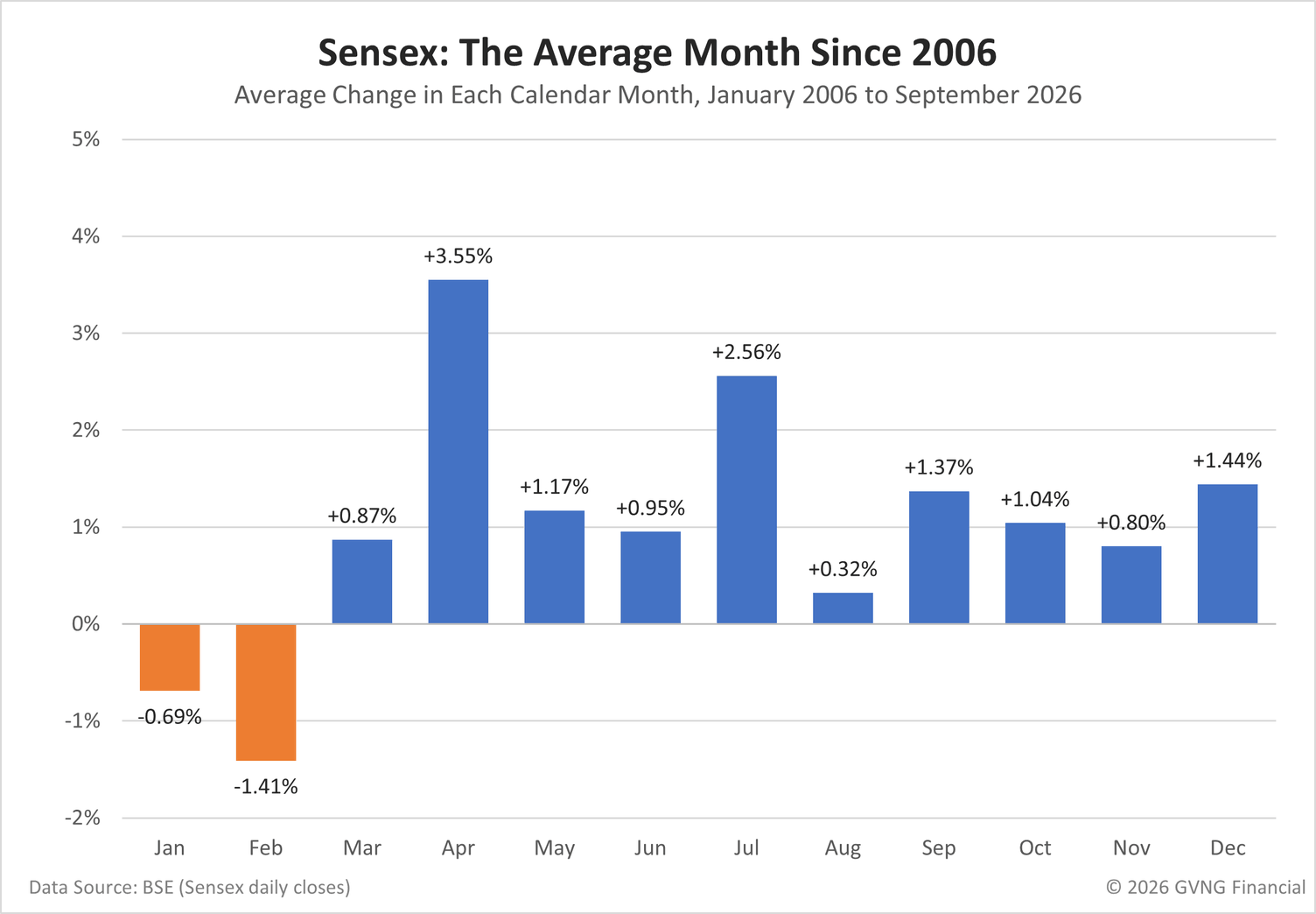
The Nifty 50 fell in all of the last five Januaries and four of the last five Februaries. Since 2006 the Sensex has risen in only 8 of 21 Januaries and 8 of 21 Februaries. November and December have been ordinary; the damage has come after the new year.
Since 2006, January and February are the only months in which the Sensex has fallen on average
Sensex, average change by calendar month
Data source: BSE, Sensex daily closes, January 2006 to September 2026. An average hides wide swings from year to year.
The Budget has been a risk more often than a rally
The Nifty 50 around the February Budget
Close-to-close changes. July 2024's full Budget is left out: it was not in winter. Source: NSE
Budget
January before it
Budget day
Next session
Tue 1 Feb 2022
-0.08%
+1.37%
+1.16%
Wed 1 Feb 2023
-2.45%
-0.26%
-0.03%
Thu 1 Feb 2024 (interim)
-0.03%
-0.13%
+0.72%
Sat 1 Feb 2025
-0.58%
-0.11%
-0.52%
Sun 1 Feb 2026
-3.10%
-1.96%
+1.06%
Many investors wait for a "pre-Budget rally". The Nifty instead fell in the January before all five Budgets, and on Budget day in four. Tax rules for investors can change that day, as in 2026: a day to know about, not to bet on.
The big days were surprises
The days that moved these winters
Close-to-close change on the day. Source: NSE
Day
What happened
Move
26 Nov 2021
WHO names the Omicron variant
Nifty 50 -2.91%
24 Feb 2022
Russia invades Ukraine
Nifty 50 -4.78%, the worst day of the five winters. Nifty Bank -5.79%, Smallcap 100 -6.25%
27 Jan 2023
Worry over government banks' loans to the Adani group
Nifty PSU Bank -5.43%
4 Dec 2023
First session after four state election results
Nifty 50 +2.07%, the best day of that winter
17 Jan 2024
HDFC Bank's results
Nifty Bank -4.28%
23 Jan 2024
Sony calls off its merger with Zee
Nifty Media -12.87%
Sun 1 Feb 2026
Budget raises the tax on futures and options trades
Nifty 50 -1.96%, the largest Budget-day fall in six years
3 Feb 2026
India-US trade agreement
Nifty 50 +2.55%, the best day of that winter
None of these is a seasonal event. Diwali, weddings and cold weather come on dates everyone knows, and share prices have already counted them.
Is there a winter effect? What the research says
A famous idea in finance says winter is the good half of the year for shares. It is why people expect winter to pay.
What the research found
Seven published studies
Study
Looked at
Found
Bouman and Jacobsen, American Economic Review, 2002
37 countries
In 36, shares earned more from November to April than from May to October: the "Halloween effect", or "sell in May"
Zhang and Jacobsen, Journal of International Money and Finance, 2021
Every stock market record the authors could find, some three centuries long
November to April ahead by about 4 percentage points a year on average
Kamstra, Kramer and Levi, American Economic Review, 2003
Day length and share prices
Short days make investors more cautious, the "winter blues". Stronger in countries far from the equator
Jacobsen and Marquering, Journal of Banking and Finance, 2008
The weather explanation
The seasonal pattern is real in many countries, but the data cannot show that mood or temperature is the cause
Jaisinghani, South Asian Journal of Global Business Research, 2016
11 NSE indices, 1994 to 2014
Halloween effect not statistically significant in India
Saxena, Purohit and Malhotra, Global Business and Economics Review, 2021
Nifty 50, 2011 to 2018
No month-of-the-year effect. India's calendar patterns are "diminishing"
Ghalke and others, IIMB Management Review, 2023
The one-hour Muhurat session on Diwali evening
Returns higher than on other new-moon days, more so in small companies, where individual investors do more of the trading
Mumbai's shortest day is about eleven hours and London's under eight, so a short-day effect should be weak in India. The Muhurat finding is about one hour, not a season.
Our own test: 36 winters of the Sensex
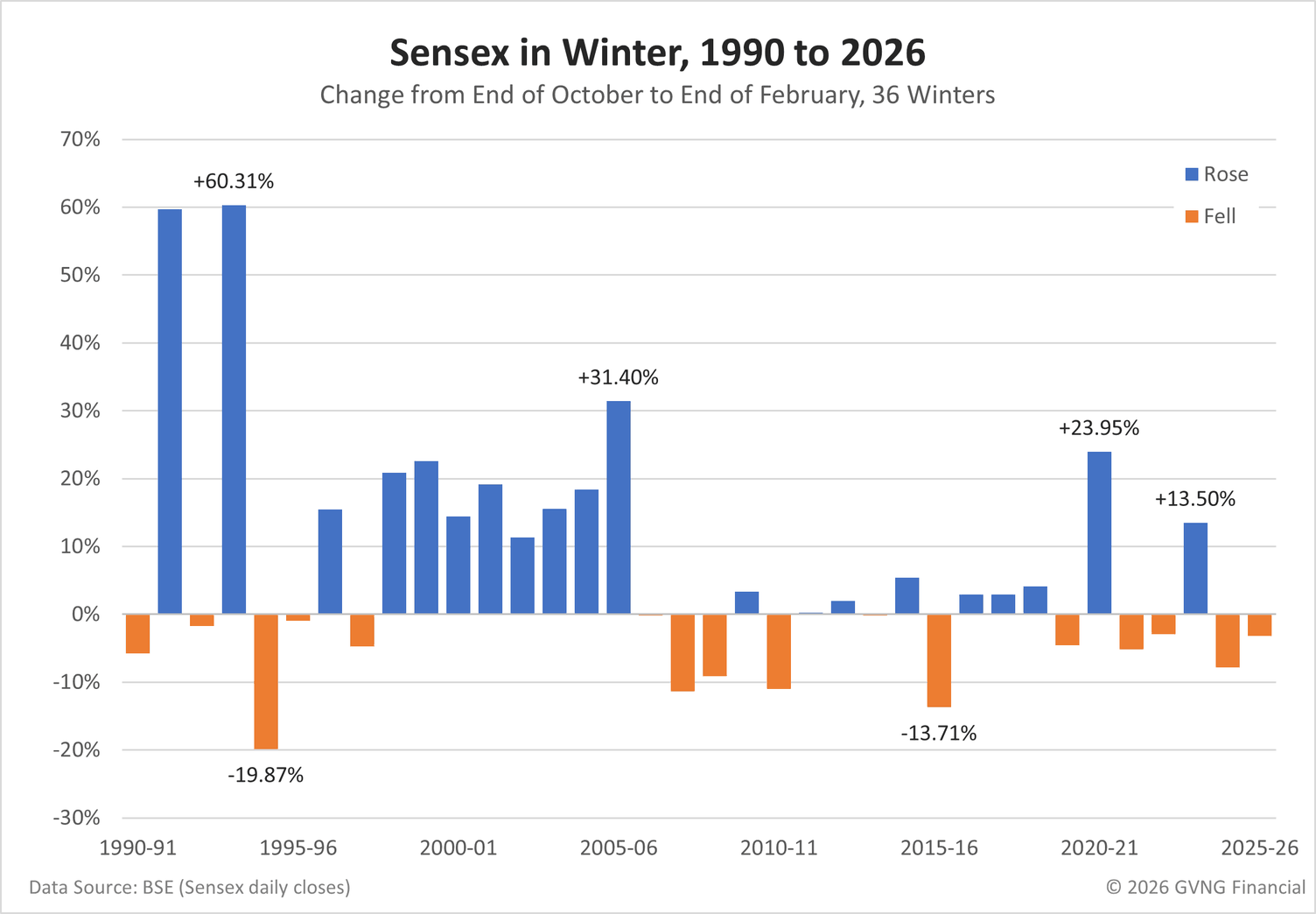
The Sensex used to have strong winters. In the last twenty years the typical winter has been close to zero
Sensex, end of October to end of February, 1990-91 to 2025-26
Data source: BSE, 8,903 daily closes of the Sensex from January 1990. The winters of 1991-92 and 1993-94 each gained about 60%.
First 16 winters (1990-91 to 2005-06): the Sensex rose in 11. The typical (median) winter gained 15.5%.
Last 20 winters (2006-07 to 2025-26): it rose in 9. The typical winter fell 0.2%.
March to October, the same 20 years: it rose in 17.
The Halloween test, all 36 years: the average month gained 1.36% from November to April and 1.33% from May to October. No real difference, and a standard statistical test agrees.
India's winter effect belonged to the years after the economy opened up. A rule that works in 36 other countries has not worked here for twenty years.
Sectors in winter
Winter does change business: hotels fill up, jewellers sell more, cold cream moves off the shelves. The investor's question is whether the shares rose.
NSE sector indices, November to February
Last October close to last February close. Source: NSE
Index
2021-22
2022-23
2023-24
2024-25
2025-26
Winters up
Nifty CPSE
+5.66%
+2.89%
+48.78%
-18.36%
+7.12%
4 of 5
Nifty PSU Bank
-5.58%
+5.70%
+40.44%
-15.96%
+19.99%
3 of 5
Nifty Metal
+5.99%
-10.64%
+22.77%
-11.88%
+15.35%
3 of 5
Nifty Energy
+4.20%
-18.71%
+45.00%
-23.62%
+2.12%
3 of 5
Nifty Auto
-4.22%
-4.86%
+28.25%
-12.83%
+5.03%
2 of 5
Nifty Bank
-7.44%
-2.51%
+7.64%
-6.08%
+4.76%
2 of 5
Nifty IT
-1.63%
+3.26%
+23.34%
-7.65%
-14.30%
2 of 5
Nifty Pharma
-6.86%
-11.09%
+29.42%
-12.85%
+3.50%
2 of 5
Nifty FMCG
-7.08%
+1.45%
+5.37%
-14.38%
-9.01%
2 of 5
Nifty Infrastructure
-4.88%
-4.16%
+32.65%
-13.12%
-0.35%
1 of 5
Nifty Consumer Durables
-1.73%
-11.27%
+14.20%
-12.14%
-2.67%
1 of 5
Nifty Realty
-12.49%
-10.36%
+51.00%
-20.17%
-17.62%
1 of 5
Nifty Media
-10.48%
-17.34%
-6.78%
-31.31%
-7.94%
0 of 5
All but media rose in 2023-24, and all fell in 2024-25. The season of the market mattered more than the season of the sector.
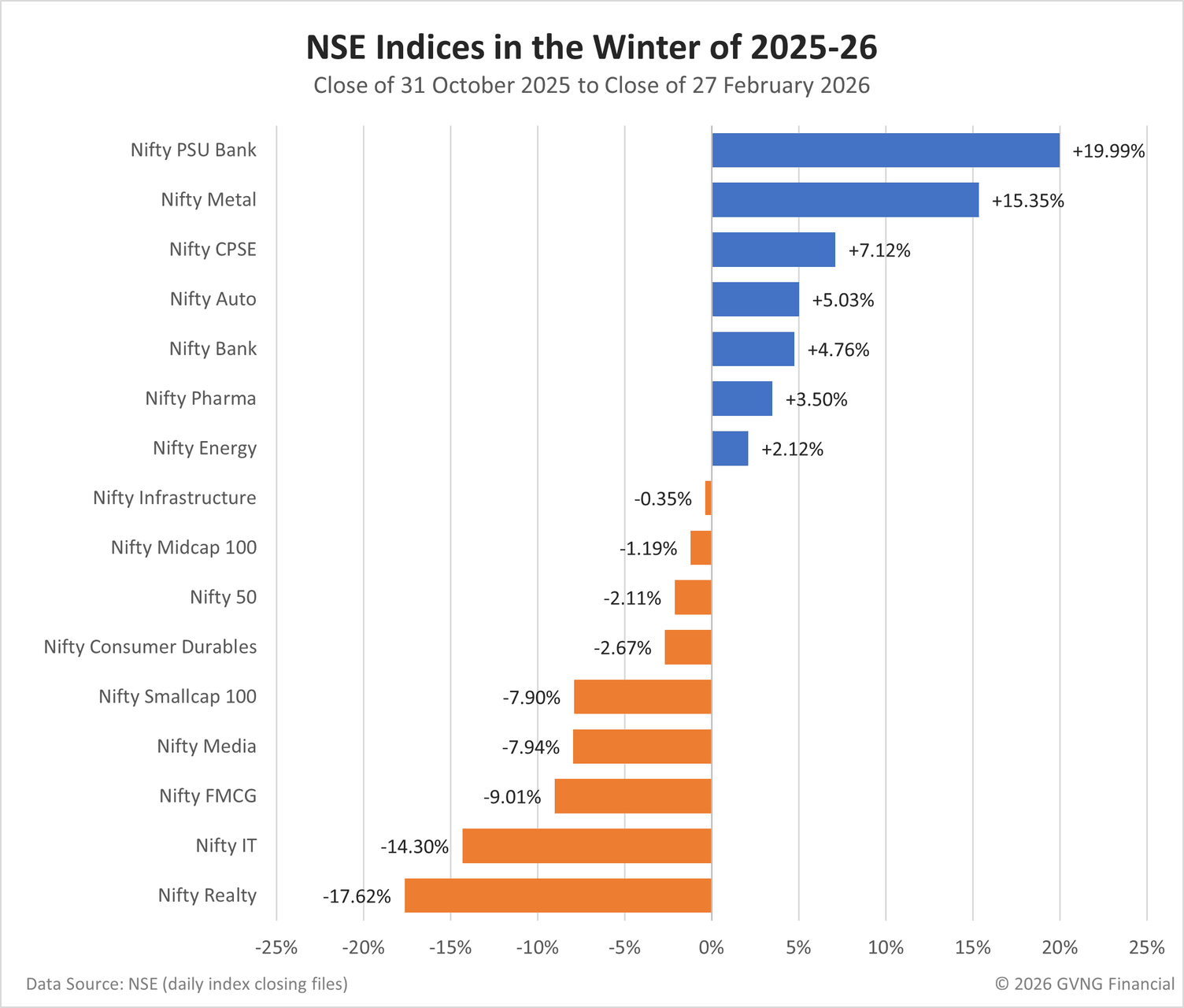
Last winter: government banks and metals rose, IT and property fell
NSE indices, 31 October 2025 to 27 February 2026
Data source: NSE daily index closing files.
Before winter and during winter
A sector's season starts early: Diwali and wedding dates are known months ahead, and investors buy before them. So we set July to October against winter. "Typical" is the middle value of the five years.
NSE indices before winter and during winter, 2021 to 2025
July to October = last June close to last October close. Last column: 30 June to 9 October 2026. Source: NSE
Index
Jul to Oct: years up
Jul to Oct: typical
Nov to Feb: years up
Nov to Feb: typical
Jul to 9 Oct 2026
Nifty 50
4 of 5
+0.8%
1 of 5
-3.9%
-5.6%
Nifty Realty
3 of 5
+13.9%
1 of 5
-12.5%
-3.1%
Nifty PSU Bank
4 of 5
+13.6%
3 of 5
+5.7%
-4.3%
Nifty CPSE
3 of 5
+11.4%
4 of 5
+5.7%
-10.4%
Nifty Media
4 of 5
+8.7%
0 of 5
-10.5%
+5.1%
Nifty Metal
4 of 5
+6.7%
3 of 5
+6.0%
-4.1%
Nifty Pharma
4 of 5
+6.7%
2 of 5
-6.9%
+2.5%
Nifty Auto
4 of 5
+6.6%
2 of 5
-4.2%
-6.1%
Nifty Energy
3 of 5
+6.2%
3 of 5
+2.1%
-10.0%
Nifty Infrastructure
4 of 5
+6.2%
1 of 5
-4.2%
-8.7%
Nifty FMCG
4 of 5
+4.3%
2 of 5
-7.1%
-8.1%
Nifty IT
4 of 5
+3.5%
2 of 5
-1.6%
+8.6%
Nifty Consumer Durables
5 of 5
+3.4%
1 of 5
-2.7%
-1.3%
Nifty Bank
3 of 5
+0.8%
2 of 5
-2.5%
-4.0%
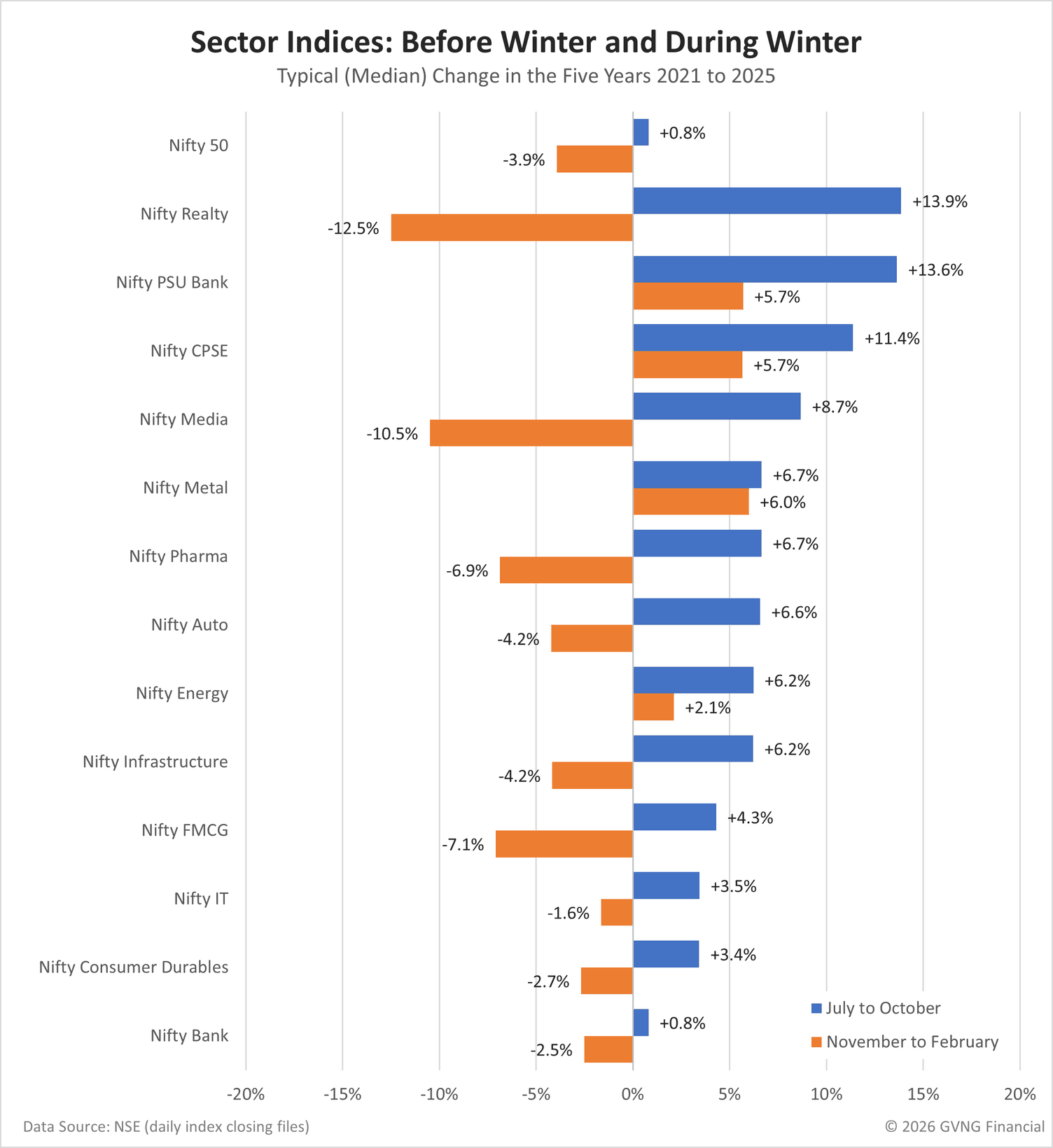
For every sector index, the typical July to October was better than the typical winter
Typical change before winter and during winter, 2021 to 2025
Data source: NSE daily index closing files.
The run-up was the stronger half. Across 13 sector indices and five years, 65 cases, the index rose in 49 run-ups and 26 winters.
A rise before winter did not secure one in winter. Of the 49 that rose before winter, 22 also rose in it. Of the 16 that fell, 4 did.
Leaders stayed ahead, often by falling less. In four of five years the four best sectors before winter beat the four worst during it, yet lost money on average in three of the five winters.
This year is different going in. In the last five years, 1, 0, 2, 8 and 5 of the 13 sector indices fell between July and October. So far in 2026 it is 10 of 13: only IT, Media and Pharma are higher.
Consumer goods: the winter shelf
The business. Chyawanprash, honey, cough syrups, cold creams and balms sell mainly in the cold, so October to December is the quarter that counts. Dabur blamed a late winter in the December quarters of 2023 and 2024, and Emami in 2024, when Dabur's revenue grew about 3% and its healthcare sales fell 1.3%. The winter of 2025-26 came in cold: Emami's domestic sales grew 11% and BoroPlus 16%.
The shares. Nifty FMCG still fell 9.01% that winter. On the night of 31 December 2025 the government announced a new excise duty on cigarettes, and ITC, the largest company in the index, fell 9.7% the next day and about 20% over January.
Travel: airlines and hotels
The business. October to March is the peak for travel. IndiGo, India's largest airline, made a December-quarter net profit of ₹1,422 crore in 2022, ₹2,998 crore in 2023 and ₹2,449 crore in 2024. In 2025 it made ₹550 crore, after cancelling thousands of flights in early December at a cost of about ₹577 crore and booking ₹969 crore for new labour rules.
The shares. The Nifty India Tourism index, which has two full winters of data, fell 2.17% in 2024-25 and 12.53% in 2025-26. The peak is in the timetable every year; what moved the shares was not.
Jewellery: strong before winter, weaker in it
The business. October to December is usually the jewellers' biggest quarter: Dhanteras and Diwali are among the heaviest gold-buying days, and many Hindu wedding dates fall between November and February. The traders' body CAIT estimated 38 lakh weddings and ₹4.74 lakh crore of spending for the season from November 2023, and 46 lakh weddings and ₹6.5 lakh crore for November and December 2025.
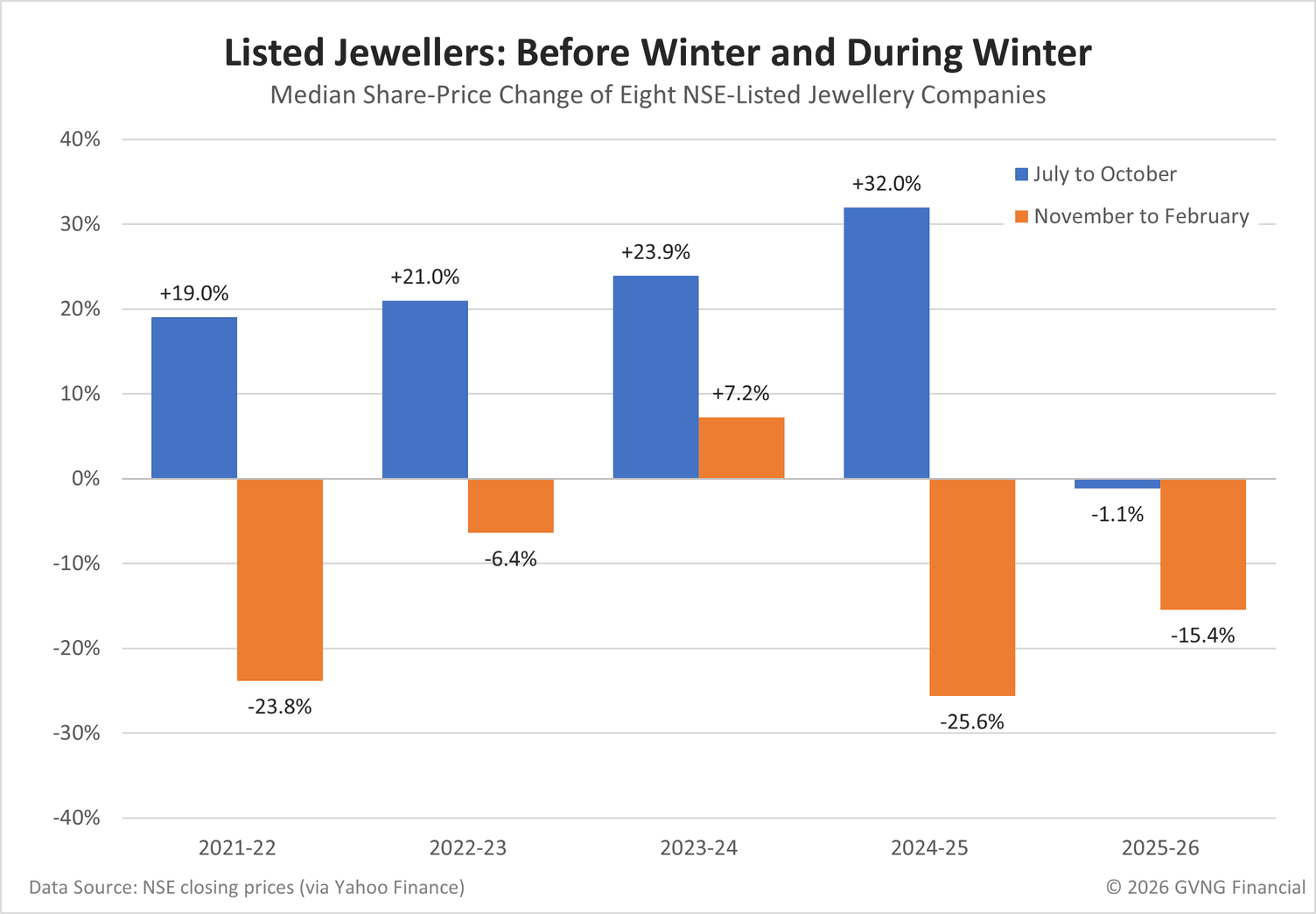
The shares. The NSE has no jewellery index, so we followed the middle one of the eight jewellers listed since before June 2021, which no single company can swing. It rose 19% to 32% before winter in each year from 2021 to 2024, and fell in four of the five winters, by 6% to 26%.
In four of the last five years jewellery shares rose before winter. In four of five they fell during it
The typical listed jeweller: July to October, then November to February
Data source: NSE closing prices of eight listed jewellery companies, adjusted for share splits. Not a recommendation on any share.
Gold did the opposite. A gold exchange-traded fund, which follows the rupee price of gold, rose in all five winters, by 1.4% to 31.6%. When gold is dear, customers buy fewer grams and more coins and bars, on which a jeweller earns little: in the quarter to March 2026 Titan's income rose 80% while its gross margin fell six percentage points.
Right now: a good run. Of the 13 jewellers now listed, 9 are above their 30 June price and the middle one is up 11.9%, while the Nifty 50 fell 5.64%. The spark was Kalyan Jewellers' 7 July update of about 38% revenue growth for April to June; its share rose 77% by 29 July. In early October Kalyan reported about 26% growth for July to September and Titan about 21% in jewellery; Titan added that some festive buying has moved to the December quarter, as Diwali is nearly three weeks later this year. The run is uneven: Titan is where it was in June. Such a run-up is the usual pattern; holding it through winter has been rare. That is the past, not a forecast: gold is now 16% below its peak of 29 January 2026, where in most of those winters it was rising.
Cars, two-wheelers and tractors
The business. Navratri to Diwali are the biggest selling weeks of the year. In the 42 festive days of 2025, just after GST on small cars and two-wheelers was cut, dealers sold a record 52.38 lakh vehicles, 21% more than a year earlier, says the dealers' federation FADA.
The shares. Nifty Auto rose 5.03% that winter, after falling in three of the previous four: a change in the rules, not the season.
IT services
The business. October to December is the slow quarter: US and European clients shut for the holidays and send contract staff on unpaid leave, called furloughs.
The shares. The index still rose 23.34% in 2023-24. It fell 12.5% in February 2025 on worries about US growth and tariffs, and 19.5% in February 2026, when a new AI tool from the US company Anthropic set off a worldwide sell-off in technology shares. Neither fall was about furloughs.
Banks
The business. Bankers call October to March the busy season: crops are bought, festivals financed, and companies borrow before the year ends. Cash also gets tight: advance tax in mid-December typically pulls more than ₹1 lakh crore out of the banking system. In January 2025 the shortfall passed ₹3 lakh crore, the deepest in about fifteen years, and on 27 January the RBI moved to put about ₹1.5 lakh crore back.
The shares. Nifty Bank rose in two of five winters and Nifty PSU Bank, the government-owned banks, in three: the best winter record among banks, and still not dependable.
Property, cement and construction
The business. Building picks up after the monsoon. Around Delhi, winter also brings smog and the pollution rules known as GRAP, whose strictest stage stops all construction, roads and flyovers included. It applied from 13 to 24 December 2025 and again from 17 January 2026. The consultancy Anarock estimates that a month's ban delays a project by three to four months.
The shares. Nifty Realty fell in four of five winters. But Delhi is one region; the index covers the country and moves mostly with interest rates and home sales. We cannot say the pattern has a seasonal cause.
Government companies, energy and the Budget
The business. The Budget sets central government spending on roads, railways, power and defence: ₹11.2 lakh crore for 2025-26, raised to ₹12.2 lakh crore for 2026-27. Many of the companies that carry it out are government-owned.
The shares. Nifty CPSE has the best record in our table: four winters of five. Nifty Energy shows how one event can swamp a season: its worst winter was that of the Adani report, its best the one after.
Media: a pattern without a reason
Nifty Media fell in all five winters, and we can find no seasonal reason. Each fall had its own cause: the Zee and Sony merger collapsing in January 2024, the broad fall in smaller companies in 2024-25. It can also be luck: a coin lands the same way five times running about once in sixteen tries, and we looked at thirteen indices.
The lesson: a busy season is not a rising share price
Share prices move when results differ from what was expected, not when business is good. Everyone expects full hotels in December, so full hotels change nothing. A late winter, cancelled flights, a tax announced on New Year's Eve: these move prices, because nobody had counted them. It is why seasonal patterns fade once they are widely known.
This winter: what is different in 2026-27
No forecasts here: only the conditions this winter starts with, and the dates in the diary.
Where this winter starts
Latest readings, early October 2026
Measure
Reading
Nifty 50
22,520.45 on 9 October, down 13.81% for the year. Last winter began less than 2% below the record close of the time
Foreign investors
Sold ₹2.47 lakh crore of Indian shares between March and September
RBI repo rate
Raised to 5.50% on 7 October
Oil
Above $100 a barrel
Rupee
Near 97 to the dollar
Monsoon 2026
12.6% below normal, the weakest since 2015 according to the weather office
Major reservoirs
About 72% full in early October
El Niño
US forecasters expect a very strong one to last through the winter
It starts from a low, not a high. El Niño, a warming of the Pacific that tends to weaken India's monsoon, matters twice. The wheat and mustard sown in November depend on stored water, and food prices feed the inflation the RBI watches. And the last El Niño winter, 2023-24, was forecast to be mild, and winter products sold late.
Dates already in the diary
As announced by 9 October 2026
Date
Event
Tue 3 Nov 2026
The US votes for its Congress
Sun 8 Nov 2026
Diwali. The exchanges have listed the one-hour Muhurat session for that evening
Tue 10 Nov 2026
Markets shut
Around 1 Dec 2026
The weather office usually publishes its winter outlook
2 to 4 Dec 2026
RBI meets, its first decision after October's rate rise
Mon 1 Feb 2027
Union Budget, by the practice of recent years. Date not announced
Feb and Mar 2027
State elections due in Uttar Pradesh, Punjab, Uttarakhand, Goa and Manipur. Schedule not announced
Winter is not a reason to buy shares, and not a reason to wait. The Nifty 50 fell in four of the last five winters, and in three of those four it rose over the next eight months. In most of those years, someone who paused a SIP for the winter skipped the lower prices and bought again at higher ones. If you hold a single-sector fund, check the tables above before assuming its season will show in its price. And money for a wedding, a fee or a trip due this winter should not be in shares in the first place.
Questions readers ask
Does the Indian stock market go up in winter?
Not reliably. The Nifty 50 fell from November to February in four of the last five winters, and the Sensex in 11 of the last 20.
Which sectors do well in winter in India?
No NSE sector index rose in all of the last five winters. Nifty CPSE, the government-owned companies, rose in four; PSU Bank, Metal and Energy in three.
Why does the Nifty often fall in January?
The Nifty 50 fell in each January from 2022 to 2026, and foreign portfolio investors were net sellers in all five, by ₹25,744 crore to ₹78,027 crore. The Budget follows on 1 February.
Do jewellery shares rise in the wedding season?
More often before it. The typical NSE-listed jeweller's share rose between July and October in four of the last five years and fell in four of the five winters.
Should I stop my SIP in winter?
The record gives no reason to. Three of the last four losing winters were followed by gains over the next eight months. This is general information, not personal advice.
How we worked, and our sources
Indian indices: NSE daily index closing files, 1 June 2021 to 9 October 2026. Sensex: BSE's index archive.
Foreign investors: NSDL, monthly FPI net investment in equity.
Jewellery and gold: NSE closing prices from Yahoo Finance, adjusted for share splits. Five-year record: Titan, Kalyan Jewellers, PC Jeweller, Thangamayil, Rajesh Exports, Goldiam International, TBZ and Vaibhav Global; for 2026 also Senco Gold, PN Gadgil, Sky Gold, Motisons and BlueStone. Gold: an NSE-listed gold exchange-traded fund.
Company and industry facts: company results and statements; FADA, CAIT, RBI, the India Meteorological Department, the Commission for Air Quality Management and the Union Budget documents; reports by Reuters, PTI and Business Standard.
Research: the seven studies in the table above.
Limits: returns are index price changes and leave out dividends. Five winters is a small sample. The figures describe the past; they are not a forecast or a recommendation to buy or sell any share, sector or fund.
Plan the winter's spending and the winter's investing together
A study tells you what markets did. Your plan decides what you should do. We can go through yours together.
Winter is when we spend. It is rarely when markets pay.
Every November the house fills up: Diwali, a wedding in the family, travel, the fees due in January. It is also when most people look at their investments and ask whether to wait for the Budget before putting in more.
In shortIn four of the last five winters the Nifty 50 fell between November and February, and in three of those four it rose over the eight months that followed. Since 2006, January and February are the only two months in which the Sensex has fallen on average.
If this winter's spending and this winter's investing are pulling in different directions, bring both to me and we will set them side by side.
Indian stock market in winter: what November to February did to the Nifty and every sector since 2022
Summarising
The short answer
From November to February the Nifty 50 fell in four of the last five winters; it rose only in 2023-24, by 15.22%. Since 2006, January and February are the only months in which the Sensex has fallen on average.
No sector index rose in all five winters (government companies came closest, four of five), and every sector typically did better in the four months before winter. What decided each winter was foreign money, the Budget and one surprise nobody had in the calendar.
01Markets in winter: five winters, one by one
Nifty 50, end of October to end of February: -4.97% in 2021-22, -3.93% in 2022-23, +15.22% in 2023-24, -8.60% in 2024-25 and -2.11% in 2025-26. Small caps swung harder, from +26.30% to -20.98%.
2021-22: Omicron and the Ukraine war, with FPIs selling ₹93,866 crore. 2022-23: a record high in December, then the Hindenburg report on Adani in January. 2023-24: state election results, a signal that US rate rises were over and ₹66,135 crore of FPI buying in December; Realty rose 51.00%.
2024-25: five falling months in a row, the first since 1996, with ₹1,18,767 crore of FPI selling; even a tax cut and the RBI's first repo cut in almost five years did not help. 2025-26: a record close of 26,328.55 on 2 January 2026, then FPI selling, a higher tax on F&O trades and an AI scare that took Nifty IT down 19.5% in February.
Three of the four losing winters were followed by eight months that more than made the money back. Not this year: from the end of February to 9 October 2026 the Nifty 50 is down 10.56%.
Foreign money set the direction. The one winter of heavy FPI buying (+₹50,931 crore in 2023-24) was the one strong winter; the two heaviest selling winters brought the two largest falls. FPIs were net sellers in every January from 2022 to 2026.
January and February are the weak months. The Nifty fell in all of the last five Januaries. Since 2006 the Sensex has averaged -0.69% in January and -1.41% in February, the only negative months, while April averaged +3.55%.
The Budget is a risk, not a rally. The Nifty fell in the January before all five Budgets and on Budget day in four; 1 February 2026 (-1.96%) was the largest Budget-day fall in six years.
The big days were surprises: Russia invading Ukraine (-4.78%, the worst day of the five winters), Sony calling off its Zee merger (Media -12.87%), the India-US trade agreement (+2.55%). Diwali, weddings and cold weather come on known dates and are already in the price.
03Is there a winter effect? What the research says
Worldwide there is a 'Halloween effect': in 36 of 37 countries shares earned more from November to April than from May to October (Bouman and Jacobsen, 2002), about 4 percentage points a year across centuries of records.
In India it does not show. Studies of NSE indices (1994 to 2014) and the Nifty (2011 to 2018) found no significant effect, and with Mumbai's shortest day at about eleven hours, a 'winter blues' effect should be weak here.
GVNG's own test of 36 Sensex winters: the first 16 (to 2005-06) rose 11 times with a typical gain of 15.5%; the last 20 rose only 9 times with a typical -0.2%, while March to October rose in 17 of those 20 years. Average month: 1.36% from November to April against 1.33% from May to October, no real difference.
Five-winter record: Nifty CPSE rose in 4 of 5, PSU Bank, Metal and Energy in 3, Realty in only 1 and Media in none. All but media rose in 2023-24 and all fell in 2024-25: the market's season mattered more than the sector's.
Before winter beats winter. For the Nifty and all 13 sector indices, the typical July to October beat the typical November to February (Realty +13.9% before, -12.5% during). Of 65 cases, 49 rose before winter and only 26 during it.
A busy season is not a rising share. Cold-weather products sold well in 2025-26 (Emami domestic sales +11%), yet FMCG fell 9.01% after a cigarette duty hit ITC. The typical listed jeweller rose 19% to 32% before winter in each year from 2021 to 2024 and fell in four of five winters, while gold itself rose in all five.
Elsewhere: IT fell 19.5% in February 2026 on an AI scare, not on holiday furloughs; record festive vehicle sales of 52.38 lakh after a GST cut lifted Auto 5.03%; Delhi's construction bans hurt builders, though the Realty index moves mostly with interest rates.
This year starts differently: 10 of 13 sector indices fell from July to early October 2026; only IT, Media and Pharma are higher. Jewellers are in a good run (the typical one +11.9% since 30 June), but holding such runs through winter has rarely paid.
05The lesson: a busy season is not a rising share price
Share prices move when results differ from what was expected, not when business is good. Everyone expects full hotels in December, so full hotels change nothing.
A late winter, cancelled flights or a tax announced on New Year's Eve move prices, because nobody had counted them. That is why seasonal patterns fade once they are widely known.
It starts from a low, not a high: the Nifty 50 at 22,520.45 on 9 October, down 13.81% for the year; FPIs sold ₹2.47 lakh crore from March to September; the repo rate raised to 5.50%; oil above $100; the rupee near 97 to the dollar.
The monsoon was 12.6% below normal, the weakest since 2015, reservoirs are about 72% full, and a very strong El Niño is expected through winter. That matters for wheat sowing, food prices and the inflation the RBI watches.
In the diary: the US Congress vote on 3 November, Diwali and the Muhurat session on 8 November, the RBI meeting on 2 to 4 December, the Union Budget expected on 1 February 2027 and state elections in February and March 2027.
For investors: winter is not a reason to buy and not a reason to wait. Those who paused a SIP for winter mostly skipped the lower prices and bought back higher. Money needed this winter for a wedding, fees or a trip should not be in shares at all.
Does the market rise in winter? Not reliably: the Nifty 50 fell in 4 of the last 5 winters and the Sensex in 11 of the last 20. Best sectors? None rose in all five; CPSE rose in four.
Why January? FPIs were net sellers in every January from 2022 to 2026, by ₹25,744 crore to ₹78,027 crore, with the Budget right after. Should you stop your SIP? The record gives no reason to.
NSE daily index closing files from 1 June 2021 to 9 October 2026 (1,331 sessions), 36 years of Sensex closes from BSE, NSDL monthly FPI data, eight listed jewellers adjusted for share splits, and an NSE-listed gold ETF.
Returns are price changes without dividends, and five winters is a small sample. The figures describe the past; they are not a forecast or a recommendation.
A summary of the article above, written by GVNG Research. Every chart, table and source is in the full article. For information only, not investment advice.