Gold ETF vs physical gold: why your family's gold should not sit only in the locker
Since 2004 the Sensex has fallen 14% or more eleven times. Gold in rupees rose in eight of those falls, and in every one since 2008. What that means for the gold Indian families own, and the form it is held in.
Almost every Indian family owns gold. Some of it came as a wedding gift, some was bought one Dhanteras at a time, and most of it sits in a locker that is opened twice a year. Brokers estimate the total at about 25,000 tonnes, worth well over the whole country's annual income at today's prices.
Very little of it is held in a form that can be sold in a minute. At the end of September 2026, gold exchange-traded funds in India held ₹1.86 lakh crore. On our estimate that is about one rupee of every two hundred that Indian families have in gold. The rest is jewellery, coins and bars.
That matters because of what gold does when shares fall. We checked every fall of 14% or more in the Sensex since 2004 against the price of gold in rupees over the same days. This study sets out what we found, why it happens, when it did not, what a slice of gold did to a portfolio, and why the gold in the locker cannot do that job.
The short answer
Since 2004 the Sensex has fallen 14% or more eleven times. Gold in rupees rose in eight of those falls, and in every one since 2008. A portfolio with 15% in gold, rebalanced once a year, lost less in each fall and ended with more than one in shares alone. That only works with gold you can sell on a market day, at the market price, and buy back just as easily. Jewellery is family wealth. For a portfolio, the gold has to be held in a form like a gold ETF.
What gold did each time the Sensex fell
A fall here runs from a closing high of the Sensex to its lowest close before it got back above that high. We used the international gold price turned into rupees each day, so the numbers show gold itself, without India's import duty (more on the duty below).
Every Sensex fall of 14% or more since 2004, and gold over the same days
Closing high to lowest close. Gold: international price in rupees. Sources: BSE; COMEX gold and USD/INR via Yahoo Finance
Fall
High to low
Sensex
Gold in rupees
Rupee against the dollar
2004: election-result shock
14 Jan to 17 May 2004
-27.3%
-9.8%
-0.2%
2006: global sell-off
10 May to 14 Jun 2006
-29.2%
-18.3%
-2.2%
2007: February sell-off
8 Feb to 5 Mar 2007
-15.3%
-2.2%
-1.0%
2008-09: global financial crisis
8 Jan 2008 to 9 Mar 2009
-60.9%
+38.1%
-24.3%
2010-11: euro debt crisis
9 Nov 2010 to 20 Dec 2011
-27.5%
+36.3%
-15.9%
2015-16: China slowdown
29 Jan 2015 to 11 Feb 2016
-22.7%
+10.1%
-9.6%
2018: IL&FS default
28 Aug to 26 Oct 2018
-14.3%
+6.9%
-4.5%
2020: Covid crash
14 Jan to 23 Mar 2020
-38.1%
+8.6%
-6.5%
2021-22: rate rises, Ukraine war
18 Oct 2021 to 17 Jun 2022
-16.8%
+8.4%
-3.8%
2024-25: foreign selling
26 Sep 2024 to 4 Mar 2025
-15.0%
+13.2%
-4.2%
2026: oil shock, weak rupee
2 Jan to 8 Oct 2026
-16.5%
+3.3%
-7.0%
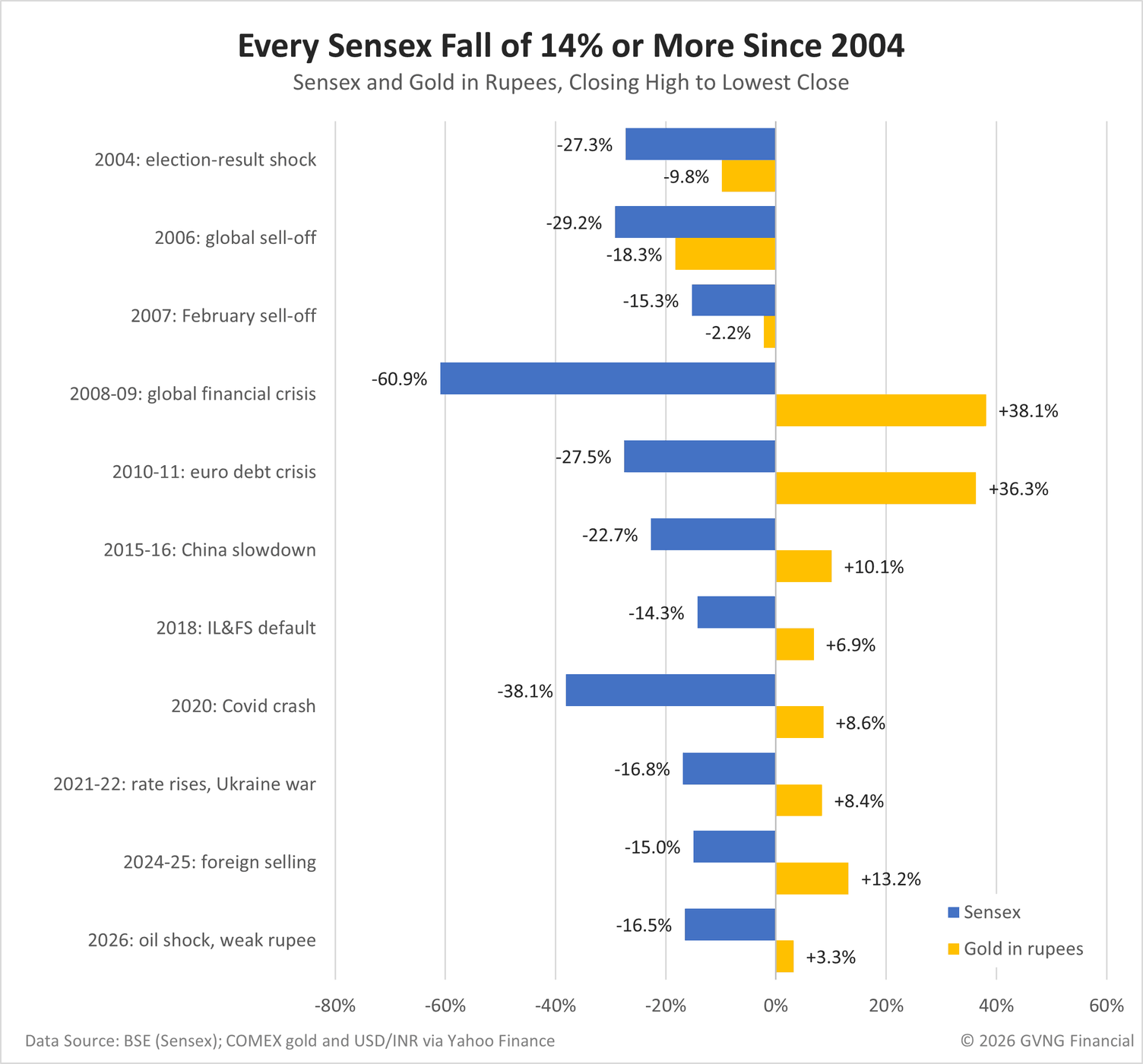
Two patterns stand out. The three falls in which gold also fell came before 2008, were shorter, and happened while the rupee held steady. In the long, deep falls gold did the opposite of shares: in the 2008 crisis the Sensex lost 60.9% and gold in rupees gained 38.1%.
In every big Sensex fall since 2008, gold in rupees rose
Each fall from its closing high to its lowest close, and gold over the same days
Data source: BSE (Sensex); COMEX gold futures and USD/INR via Yahoo Finance. Past returns do not tell you future returns.
The monthly record says the same thing in a different way. Since December 2003 there have been 29 months in which the Sensex fell 5% or more. Gold in rupees rose in 21 of them. In those 29 months the Sensex lost 9.5% on average and gold gained 2.8%. Over all 274 months, the two moved almost independently of each other: the correlation of their monthly returns is -0.07, where 1 would mean they move together and 0 that they are unrelated.
Why gold rises in rupees when Indian shares fall
Look at the last column of the table. In every fall since 2008 the rupee also lost value against the dollar. That is not a coincidence. When Indian shares fall hard, foreign investors are usually selling, and to take their money home they sell rupees and buy dollars. Gold is priced in dollars around the world. So even when gold does nothing in dollars, a weaker rupee makes it worth more in rupees.
The 2008 crisis shows it plainly. Gold in dollars rose only 4.5% between the Sensex high of January 2008 and its low of March 2009. The rupee lost 24.3% against the dollar over the same months, and gold in rupees rose 38.1%. In 2015-16 and again this year, gold in dollars fell, by 0.5% and 4.0%, while gold in rupees rose, because the rupee fell further.
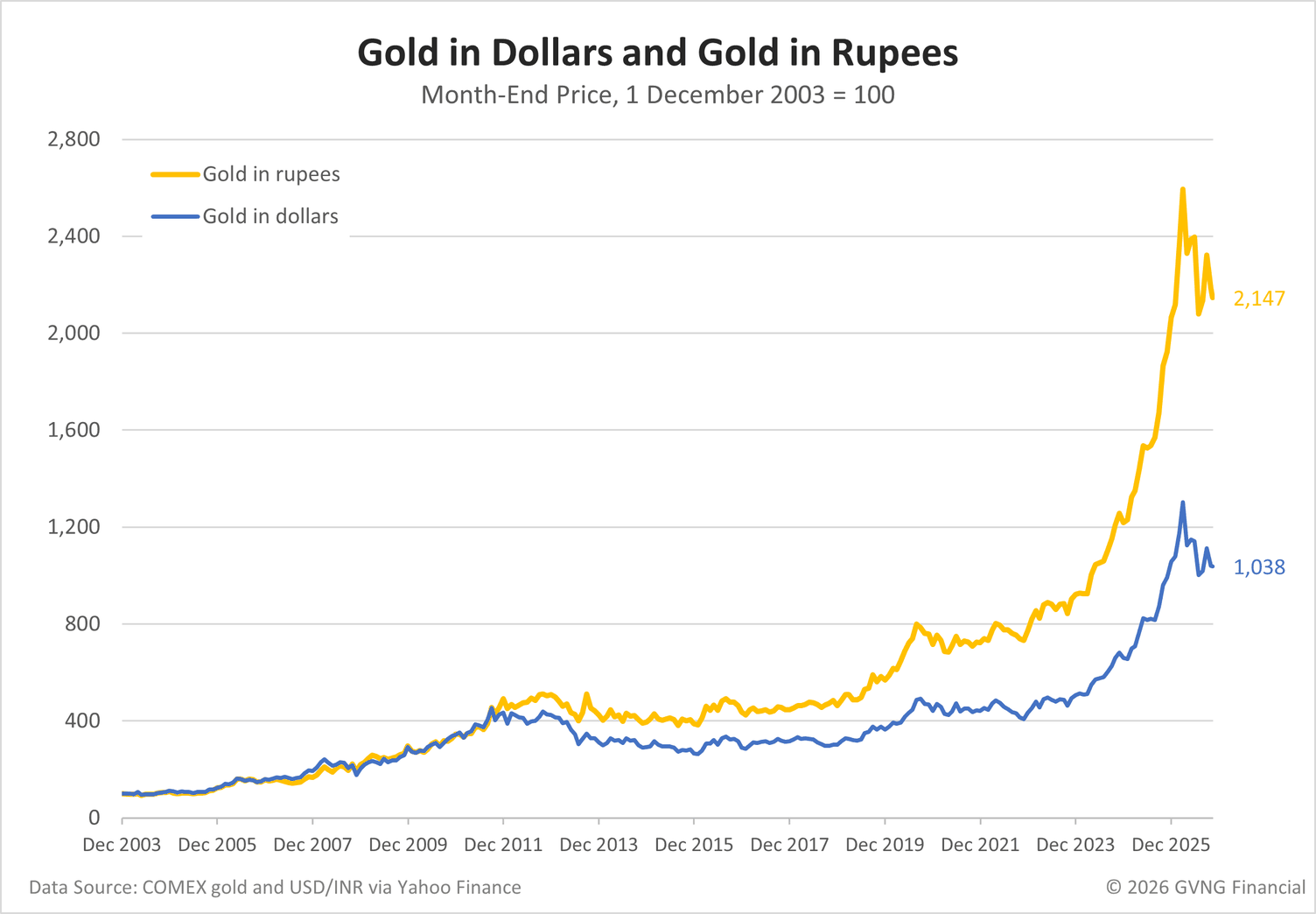
The weaker rupee doubled what gold earned an Indian
Gold in dollars and gold in rupees, 1 December 2003 = 100
Data source: COMEX gold futures and USD/INR via Yahoo Finance. International price, no Indian import duty. Past returns do not tell you future returns.
Since December 2003 gold in dollars has multiplied by 10.4 and the dollar has gone from ₹45.71 to ₹94.52. Together they turned gold in rupees into 21.5 times its starting price.
The research agrees, with one useful twist. Baur and Lucey (Financial Review, 2010) found that gold was a hedge against shares on average and a "safe haven" in crashes in the US, the UK and Germany, though only for a few weeks at a time. Baur and McDermott (Journal of Banking and Finance, 2010) then looked at gold priced in dollars and found it was not a safe haven for the large emerging markets, India among them. Gürgün and Ünalmış (Finance Research Letters, 2014) asked the question from the side of a local investor, in local money. For domestic investors, they found, gold was both a hedge and a safe haven in most emerging and developing countries, also after 2008. Our rupee numbers above fit that finding.
The World Gold Council made the same case for India in March 2026. Its research note argues that Indian government bonds now move more with shares than they used to, so bonds alone give less cover, while gold has mostly moved against Indian shares.
When gold did not help
Gold is not a promise. Three of the eleven falls in the table saw gold fall too, the worst in June 2006, when gold lost 18.3% alongside the Sensex. In March 2026, as the oil shock hit, the Sensex lost 11.5% in the month and gold in rupees 10.2%: in a rush for cash, people sell what they can, and gold is easy to sell.
Gold also has long dry spells. Gold in rupees peaked on 14 September 2012 and did not close above that level again until 24 June 2019, almost seven years later. In 2013 it fell 19.0% while the Sensex rose 9.0%. And after its record of 29 January 2026, gold in rupees is 19.3% lower today. Gold pays no dividend and no interest, and Erb and Harvey (Financial Analysts Journal, 2013) warn that its price can stay far from any "fair" level for years.
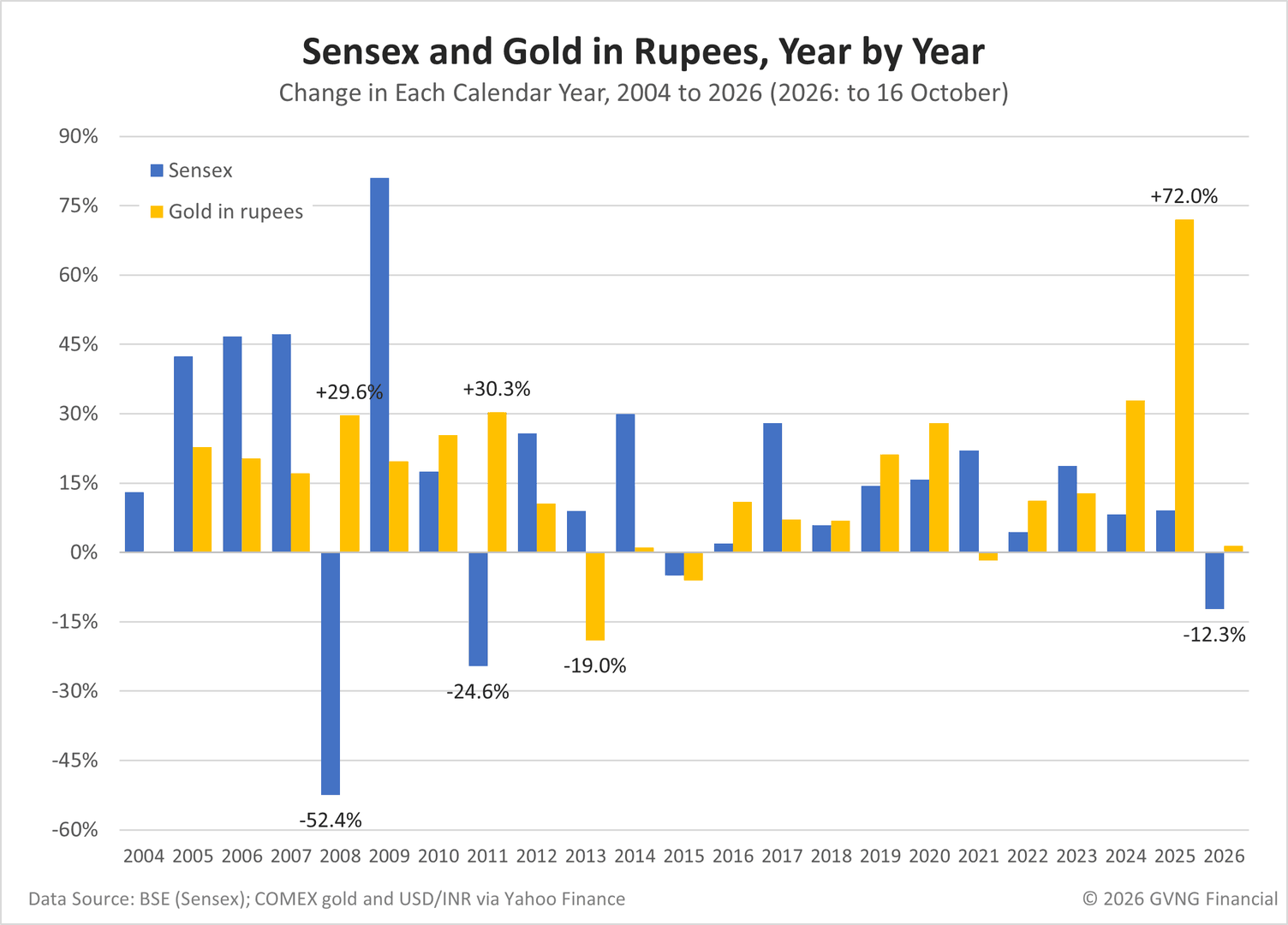
In the years shares fell, gold mostly rose
Calendar-year change of the Sensex and of gold in rupees; 2026 to 16 October
Data source: BSE (Sensex); COMEX gold futures and USD/INR via Yahoo Finance. Past returns do not tell you future returns.
Across the 23 calendar years the two fell together only once, in 2015, and both falls were small: the Sensex lost 5.0% and gold 6.1%. That is the real point of gold. It is not that gold always rises. It is that gold and shares have rarely had bad years at the same time.
What 15% in gold did to ₹10 lakh
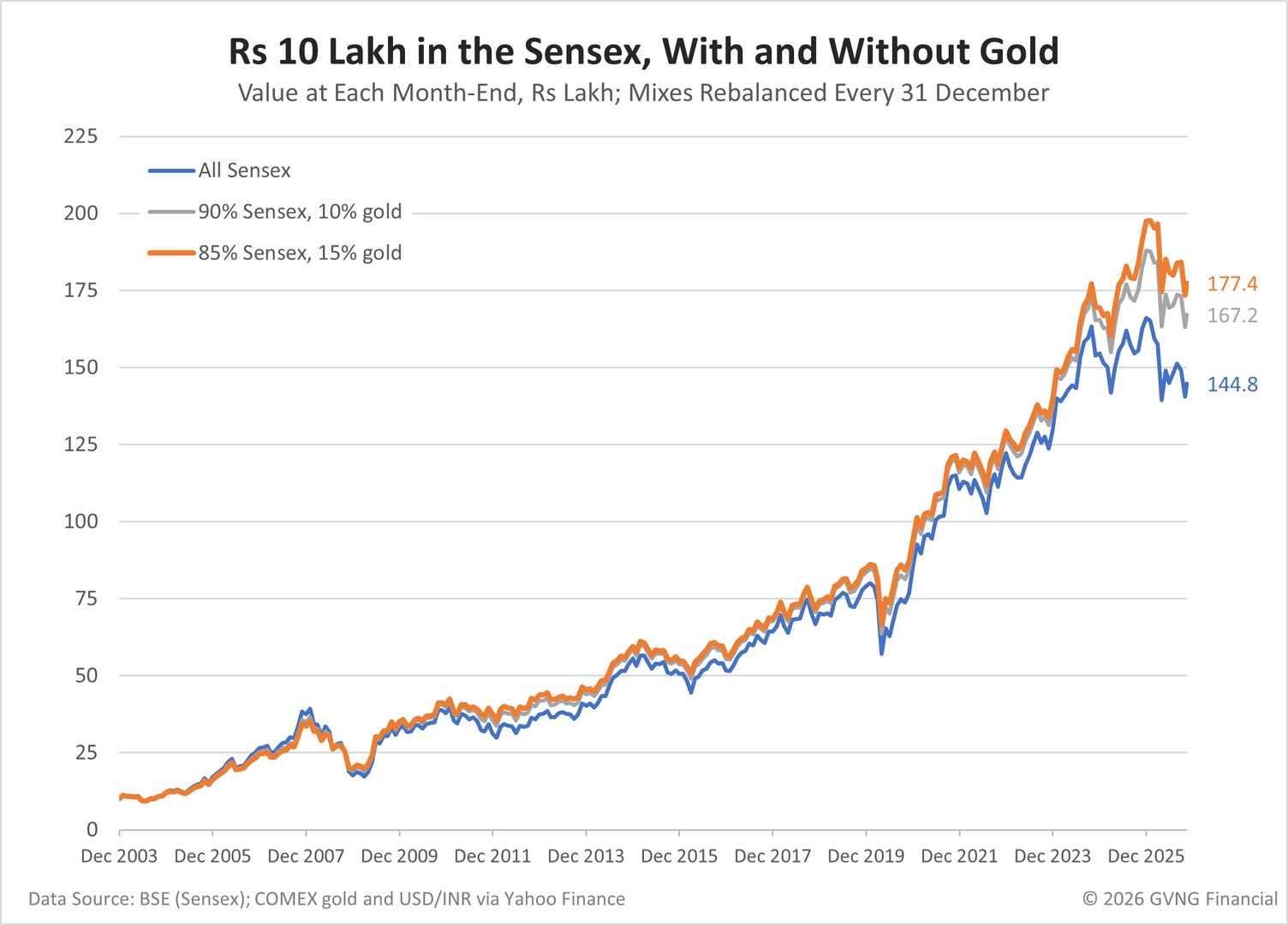
To see what this means for an investor, we put ₹10 lakh to work on 1 December 2003 in three ways: all in the Sensex, 90% Sensex with 10% gold, and 85% Sensex with 15% gold. The two mixed portfolios were set back to their starting weights at the end of every year. When shares had a bad year, that meant selling some gold and buying shares; after a good year for shares, the reverse.
₹10 lakh from 1 December 2003 to 16 October 2026
Rebalanced every 31 December. Sensex without dividends. Sources: BSE; COMEX gold and USD/INR via Yahoo Finance
All Sensex
90% Sensex, 10% gold
85% Sensex, 15% gold
Value today
₹144.8 lakh
₹167.2 lakh
₹177.4 lakh
Growth a year
12.39%
13.10%
13.40%
2008-09 crisis
-60.9%
-53.1%
-49.0%
2020 Covid crash
-38.1%
-33.4%
-31.1%
2026 so far, high to low
-16.5%
-14.6%
-13.6%
The portfolio with 15% in gold lost less in every fall and ended ₹32.6 lakh ahead. After 2008 it was back at its old high in April 2010, seven months before the all-share portfolio. Most of that came from the yearly rebalancing: the same 85:15 portfolio left alone, never rebalanced, would have ended at ₹155.3 lakh, ₹22.1 lakh less. Buying shares with gold money after a crash is where the extra came from.
A slice of gold: smaller falls, and more at the end
₹10 lakh on 1 December 2003, value at each month-end, rebalanced every year
Data source: BSE (Sensex); COMEX gold futures and USD/INR via Yahoo Finance. A back-test, not a forecast. Past returns do not tell you future returns.
Two checks before reading too much into it. First, gold's 72% rise in 2025 flatters the end result, so we stopped the test at the end of 2023: the gold mix was still ahead, ₹149.2 lakh against ₹140.0 lakh. Second, the Sensex figures leave out dividends. Adding an estimated 1.25% a year to the shares, the gold mix still ends ahead, ₹225.5 lakh against ₹192.4 lakh. It did not win every time: across the 155 ten-year stretches in the record, it beat shares alone in 105, about two in three.
Why the gold in your locker cannot do this job
Everything in the last section depends on one action: selling some gold after a crash and putting the money into shares. Almost no family does that with a wedding necklace, and they should not have to. Jewellery carries memory and meaning. For a portfolio, the gold has to be gold you are willing and able to sell.
Cost matters too. A jeweller's making charges usually run from 3% to 25% of the gold's value, and 3% GST is added to the bill. When you sell, the making charges are gone, and many jewellers deduct a further amount. A gold ETF is bought and sold on the stock exchange, through the same demat account as your shares, at the market price, on any trading day, in amounts as small as one unit.
The ways to hold gold in India, side by side
As of 17 October 2026. Tax: long-term gains, before cess and surcharge. Sources: SEBI, RBI, AMFI, Budget 2026 as reported, jewellers' published charges
Form
What you pay on top
How you sell
Tax on long-term gains
Regulated by
Jewellery
Making charges of about 3% to 25%, plus 3% GST
To a jeweller, at its buying rate; making charges are lost
12.5% after 24 months
BIS hallmark for purity only
Coins and bars
3% GST plus the seller's premium
To a jeweller or dealer, at its buying rate
12.5% after 24 months
BIS hallmark for purity only
Gold ETF
Brokerage, and the fund's yearly expense ratio
On NSE or BSE on any trading day, at the market price
12.5% after 12 months
SEBI
Gold fund (fund of funds)
The fund's expense ratio and that of the ETF it holds
Redeem with the fund house; fresh money paused since 15 Oct 2026
12.5% after 24 months
SEBI
Sovereign Gold Bond (already issued)
The market price on the exchange; 2.5% a year interest
On NSE or BSE, or at RBI's early-exit dates after five years
Tax-free at maturity only for original buyers; otherwise 12.5% after 12 months
RBI
MCX gold contract
Margin and brokerage
Close the position in any trading session; contracts expire
Taxed as business income
SEBI, through MCX
"Digital gold" on apps
3% GST plus the app's spread
Back to the app, at its rate
12.5% after 24 months
Not regulated by SEBI
The physical gold you already own still counts for something: it is wealth, and it can be pledged for a loan. What it cannot do is the yearly sell-a-little, buy-a-little that cushioned the portfolio above.
Ways to hold gold you can sell, as of October 2026
This year has changed the rules more than once, so here is where things stand on 17 October 2026.
Gold ETFs are open. They trade on NSE and BSE like shares, and each unit is backed by physical gold held in vaults for the fund. Indians put ₹4,450.61 crore into them in September alone, and about ₹45,925 crore from January to September, already more than in the whole of 2025. In January 2026, for the first time, gold ETFs took in more money than equity mutual funds.
Gold funds, the mutual funds that invest in a gold ETF for you and need no demat account, stopped taking fresh money on 15 and 16 October. Seventeen fund houses paused lump sums, top-ups and new SIPs. They gave no reason in their notices; Reuters reported the move followed a nudge from SEBI, ahead of the festive season and with the rupee under pressure. SIPs registered before the pause continue, and selling is not affected.
Physical gold costs more to bring in. On 13 May the government raised the import duty on gold from 6% to 15%, days after the Prime Minister asked families to put off buying gold for weddings for a year. Gold imports in September were 81% lower than a year earlier. Because of the duty, Indian prices now sit about 16% above the international price, which is why a gold ETF is up about 8.8% this year while the international price in rupees is up 1.4%.
Sovereign Gold Bonds have not been issued since February 2024. Bonds already issued trade on NSE and BSE, often thinly. Since 1 April 2026 the tax-free payout at maturity applies only to the original buyers. Electronic gold receipts, which trade on BSE and since May on NSE, are regulated but still see little trading. "Digital gold" sold on apps sits outside SEBI's rules, and SEBI has warned investors about it.
MCX gold contracts are for trading, or for a business that needs to fix its price of gold in advance, such as a jeweller. Contracts start from 1 gram (Gold Petal) and 8 grams (Gold Guinea). They run on margin, so gains and losses are larger than the money put in, and they expire, so holding gold for years means rolling from one contract to the next.
Gold on MCX, through your Motilal Oswal account
GVNG Financial switches on commodities for you, explains each lot and its margin, and shares Motilal Oswal's research before your first trade. See commodities at GVNG Financial →
How much gold, and which gold
There is no single right number. The World Gold Council's March 2026 study of a typical Indian portfolio found that 7.5% to 15% in gold, from December 2006 to December 2025, gave better returns for the risk taken and smaller falls. Zerodha Varsity's look at Ray Dalio's "All Weather" mix this month used 15% in gold for India. Our own test above used 10% and 15%.
The right share for you depends on what else you hold, how soon you need the money, and how much gold your family already owns that it would never sell. On our reading, that last part should not be counted as portfolio gold at all.
What it adds up to for an Indian investor
Gold has risen in rupees in every big Sensex fall since 2008, mostly because the rupee falls when shares do. A slice of gold, rebalanced once a year, has cut the falls of an Indian portfolio and added to what it ended with. Gold has also had seven-year droughts, so it belongs beside shares, not in place of them. The gold that does this job is gold you can sell on a market day: a gold ETF in your demat account, not the jewellery in your locker.
Questions readers ask
Is a gold ETF better than physical gold?
For investing, usually. A gold ETF has no making charges or GST, is bought and sold on NSE or BSE at the market price, and becomes long-term after 12 months instead of 24. Jewellery is better for wearing and gifting.
Does gold always go up when the stock market falls?
No. Gold in rupees rose in 8 of the 11 Sensex falls of 14% or more since 2004, and in all 8 since 2008. It fell in the short falls of 2004, 2006 and 2007, and in March 2026 both fell together.
How much of my portfolio should be in gold?
Studies of Indian portfolios point to about 7.5% to 15%. The right share depends on your goals and on what you already hold. This is general information, not personal advice.
How is a gold ETF taxed in 2026?
Gains on units held for more than 12 months are taxed at 12.5%; gains within 12 months are added to your income and taxed at your slab rate. Physical gold and gold funds need 24 months to count as long-term.
Can I still invest in gold mutual funds in October 2026?
Not with fresh money for now. From 15 and 16 October seventeen fund houses paused new investments in their gold funds; SIPs registered before the pause continue. Gold ETFs bought on the exchange through a demat account remain open.
How we worked, and our sources
Shares: Sensex daily closes, 1 December 2003 to 16 October 2026 (5,619 sessions), via Yahoo Finance and checked against BSE's index archive. The Sensex here is a price index: dividends are not included.
Gold: COMEX gold futures (front month) times the US dollar's rupee rate, both via Yahoo Finance, per 10 grams. This is the international price in rupees, without India's import duty or GST. Two bad rupee readings (27 and 31 January 2012) were replaced with the median of the days around them. For 2026 we also show an NSE-listed gold ETF, which carries the duty.
Falls: from a closing high to the lowest close before the Sensex closed above that high again. The stretch since September 2024 is split at the high of 2 January 2026, because the Sensex had risen 17.5% from its March 2025 low in between; counted as one fall, gold's rise over it would read 78.5%.
Portfolios: ₹10 lakh on 1 December 2003, set back to 85:15 or 90:10 at each year-end close, no costs or tax. Dividend check: 1.25% a year added to the Sensex.
Indian gold market: AMFI monthly data on gold ETF flows and assets as reported by Business Standard and 5paisa; fund-house notices as reported by Outlook Money, CNBC-TV18 and Cafemutual; World Gold Council; Jefferies and UBS estimates of household gold; Zerodha's Daily Brief and Aftermarket Report on the import duty, electronic gold receipts and digital gold; Zerodha Varsity on the All Weather portfolio. The household-gold share in gold ETFs is our estimate: ₹1.86 lakh crore against 25,000 tonnes at the 16 October Indian price.
Research: Baur and Lucey (2010), Financial Review 45(2); Baur and McDermott (2010), Journal of Banking and Finance 34(8); Gürgün and Ünalmış (2014), Finance Research Letters 11(4); Erb and Harvey (2013), Financial Analysts Journal 69(4); World Gold Council, "Why gold in 2026? An anchor for Indian portfolios" (17 March 2026).
Workings: every series and the Excel workbook for the four charts are kept with this article.
Find the right share of gold for your portfolio
A study tells you what gold did. Your plan decides how much of it you need, and in which form. We can go through yours together.
The gold you would never sell is not the gold that protects you.
Most of us inherited our idea of gold: a mother's bangles, a grandmother's necklace, a coin bought every Dhanteras. That gold is family. It is also locked away, and in most homes it has never once been sold to buy shares after a crash.
In shortIn every Sensex fall of 14% or more since 2008, gold in rupees rose. ₹10 lakh put 85% in the Sensex and 15% in gold in December 2003, rebalanced once a year, lost 49.0% in the 2008 crisis instead of 60.9%, and is worth ₹177.4 lakh today against ₹144.8 lakh in shares alone.
Keep the jewellery for the family. If you would like to know how much gold your portfolio needs, in a form you can actually use, sit with me and we will work it out on your own numbers.
Gold ETF vs physical gold: why your family's gold should not sit only in the locker
Summarising
The short answer
Since 2004 the Sensex has fallen 14% or more eleven times. Gold in rupees rose in eight of them, including every fall since 2008, mostly because the rupee weakens when foreign investors sell Indian shares.
₹10 lakh with 15% in gold, rebalanced every year, grew to ₹177.4 lakh by October 2026 against ₹144.8 lakh all in the Sensex, and fell less in every crash. That only works with gold you can sell on a market day, such as a gold ETF, not jewellery in a locker.
Indian families hold about 25,000 tonnes of gold, yet gold ETFs hold only ₹1.86 lakh crore of it: about one rupee in every two hundred.
01What gold did each time the Sensex fell
In the long, deep falls gold went the other way. 2008-09: Sensex -60.9%, gold +38.1%. 2010-11: -27.5% against +36.3%. 2020 Covid: -38.1% against +8.6%. 2024-25: -15.0% against +13.2%. 2026: -16.5% against +3.3%.
The three falls in which gold also fell (2004, 2006 and 2007) all came before 2008, were shorter, and happened while the rupee held steady.
Month by month it is the same: in the 29 months since December 2003 when the Sensex fell 5% or more, gold rose in 21, gaining 2.8% on average while the Sensex lost 9.5%. Over all 274 months the correlation is -0.07: the two move almost independently.
02Why gold rises in rupees when Indian shares fall
In every fall since 2008 the rupee fell too. When Indian shares drop, foreign investors sell rupees for dollars to take money home; gold is priced in dollars, so a weaker rupee makes it worth more in rupees.
2008 shows it plainly: gold in dollars rose only 4.5%, the rupee lost 24.3%, and gold in rupees rose 38.1%. Since December 2003 gold in dollars has multiplied 10.4 times and the dollar has gone from ₹45.71 to ₹94.52, so gold in rupees is up 21.5 times.
Research agrees for local investors: in local money, gold is a hedge and a safe haven in most emerging markets (Gürgün and Ünalmış, 2014). The World Gold Council (March 2026) adds that Indian bonds now move more with shares, so they cushion less than gold.
Gold is not a promise. It fell in three of the eleven falls, worst in June 2006 (-18.3%), and in March 2026's oil shock both fell together (Sensex -11.5%, gold -10.2%): in a rush for cash, people sell what is easy to sell.
It has long droughts. After its peak on 14 September 2012 it did not close higher until 24 June 2019, almost seven years. It fell 19.0% in 2013 while the Sensex rose 9.0%, and today it is 19.3% below its 29 January 2026 record.
The real point: in 23 calendar years the two fell together only once, in 2015, and only slightly (Sensex -5.0%, gold -6.1%). Gold and shares have rarely had bad years at the same time.
₹10 lakh from 1 December 2003 to 16 October 2026, rebalanced every year-end: all Sensex ₹144.8 lakh (12.39% a year), 10% gold ₹167.2 lakh (13.10%), 15% gold ₹177.4 lakh (13.40%).
The 15% mix lost less in every fall (2008-09: -49.0% against -60.9%; 2020: -31.1% against -38.1%) and was back at its 2008 high in April 2010, seven months sooner.
Most of the edge came from rebalancing, using gold money to buy shares after a crash. Left alone, the same mix ends at ₹155.3 lakh, ₹22.1 lakh less.
Checks: stopped at the end of 2023, before gold's 72% rise in 2025, it still led, ₹149.2 against ₹140.0 lakh; with 1.25% a year of dividends added to shares it led ₹225.5 against ₹192.4 lakh. It beat shares alone in 105 of 155 ten-year stretches, about two in three.
The gain depends on selling some gold after a crash and buying shares. Nobody should have to do that with a wedding necklace: jewellery is memory and family wealth, not portfolio gold.
Cost: making charges of about 3% to 25% plus 3% GST, mostly lost when you sell. A gold ETF trades on NSE or BSE through your demat account, at the market price, on any trading day, from a single unit.
Long-term gains are taxed at 12.5% for most forms, but a gold ETF becomes long-term after 12 months, while jewellery, coins and gold funds take 24. Physical gold still counts as wealth and can be pledged for a loan.
06Ways to hold gold you can sell, as of October 2026
Gold ETFs are open: ₹4,450.61 crore came in during September alone and about ₹45,925 crore from January to September, already more than in all of 2025. In January 2026 they drew more money than equity funds for the first time.
Gold funds have paused fresh money: on 15 and 16 October seventeen fund houses stopped lump sums, top-ups and new SIPs. Existing SIPs and selling continue.
Physical gold costs more: import duty rose from 6% to 15% on 13 May, September imports were 81% lower, and Indian prices sit about 16% above the international price. That is why a gold ETF is up about 8.8% this year against 1.4% for the international price in rupees.
Sovereign Gold Bonds have not been issued since February 2024, and the tax-free payout now goes only to original buyers. App-based 'digital gold' sits outside SEBI's rules. MCX contracts (from 1 gram) are for trading or hedging, run on margin and expire.
There is no single right number. The World Gold Council's March 2026 study of Indian portfolios found 7.5% to 15% in gold gave better returns for the risk and smaller falls (December 2006 to December 2025); Zerodha Varsity's All Weather mix used 15%.
Your share depends on what else you hold and when you need the money. Family gold you would never sell should not be counted. Gold belongs beside shares, not in place of them.
ETF or physical? For investing, usually an ETF: no making charges or GST, the market price on NSE or BSE, and long-term after 12 months instead of 24. Jewellery is for wearing and gifting.
Does gold always rise when markets fall? No: in 8 of the 11 big falls since 2004, and all 8 since 2008. How much to hold? About 7.5% to 15%. Tax: ETF gains after 12 months at 12.5%; within 12 months, at your slab rate.
Gold mutual funds? Not with fresh money for now. Gold ETFs bought through a demat account remain open.
Sensex daily closes from 1 December 2003 to 16 October 2026 (5,619 sessions, a price index without dividends); gold as COMEX futures times the rupee rate, per 10 grams, without import duty or GST.
A fall runs from a closing high to the lowest close before that high is regained. Portfolios start with ₹10 lakh and are rebalanced at each year-end, with no costs or tax. Research used: Baur and Lucey, Baur and McDermott, Gürgün and Ünalmış, Erb and Harvey, and the World Gold Council.
A summary of the article above, written by GVNG Research. Every chart, table and source is in the full article. For information only, not investment advice.